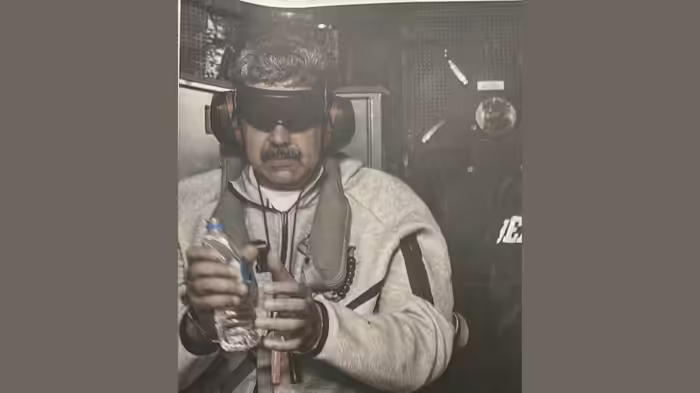
The arrest of Venezuelan President Nicolás Maduro by the United States has triggered widespread global outrage, protests in several countries, and an intense debate over the limits of international law. The dramatic operation, which reportedly involved U.S. military forces entering Venezuela and taking Maduro and his wife Cilia Flores into custody, has raised a fundamental question: Can one country legally arrest the sitting president of another sovereign nation?
The development has also become significant from the perspective of UPSC and other competitive examinations, as it touches upon core principles of international law, sovereignty, and the United Nations Charter.
What International Law Clearly States
Under established principles of international law, no country has the legal authority to arrest or detain the sitting head of state of another country through unilateral military action.
The United Nations itself reacted sharply, calling the U.S. action a “dangerous precedent” that threatens global stability. According to international law experts, the arrest of President Maduro constitutes a direct violation of the United Nations Charter, which was adopted in October 1945.
UN Charter and the Use of Force
Article 2(4) of the UN Charter explicitly prohibits the use of force in international relations. It states that all member states must refrain from using or threatening force against the territorial integrity or political independence of any state.
In simple terms, this provision bars countries from:
- Conducting military operations inside another sovereign state
- Interfering with a nation’s political leadership
- Forcibly arresting or abducting foreign leaders
The U.S. action against Venezuela, carried out without international authorization, is therefore widely seen as violating this foundational principle.
Are There Any Exceptions?
International law does recognise only two narrow exceptions under which force may be used:
- UN Security Council Authorization:
If the UN Security Council explicitly authorises action against a country under Chapter VII of the UN Charter. - Right to Self-Defence (Article 51):
If a country faces an armed attack, it may respond in self-defence.
Crucially, neither exception allows the arrest of a foreign president on allegations of corruption, election fraud, or criminal activity. There is no provision in international law permitting a state to unilaterally capture another country’s leader for domestic or international crimes.
In President Maduro’s case, no UN Security Council mandate was issued, nor was there any armed attack justifying self-defence.
Allegations Against Nicolás Maduro
The United States has accused President Maduro of leading the so-called “Cartel of the Suns” and engaging in drug trafficking over the past 25 years. According to the U.S. Department of Justice, Maduro allegedly collaborated with Colombia’s FARC guerrilla group to smuggle cocaine into the United States, endangering public health.
While such allegations may form the basis of criminal charges in U.S. courts, international law experts stress that jurisdictional claims do not override state sovereignty, especially when the accused is a sitting head of state.
Why Head of State Immunity Matters
Under customary international law, sitting heads of state enjoy immunity from arrest and prosecution by foreign courts. This immunity exists to preserve diplomatic stability and prevent powerful nations from arbitrarily targeting weaker states.
Even accusations of electoral fraud or authoritarian governance do not automatically remove this protection.
U.S. Government’s Justification
The Trump administration has defended the arrest by describing it as part of a broader military-supported law enforcement operation. Officials claim the Department of Justice sought military assistance to execute the arrest, citing national security and narcotics trafficking concerns.
However, legal scholars argue that domestic justifications cannot override international obligations, particularly those under the UN Charter.
Why This Case Matters Globally
The arrest of President Maduro has alarmed many nations, who fear that such actions could:
- Undermine international law
- Normalize cross-border military interventions
- Set a precedent for targeting political leaders under the guise of law enforcement
For students of international relations and aspirants preparing for UPSC and other competitive exams, the case highlights the continuing tension between power politics and the rule-based international order.
Conclusion
In essence, international law does not permit one country to arrest the president of another sovereign nation without UN authorization. The Maduro episode underscores how deviations from established legal norms can destabilize global diplomacy and challenge the authority of international institutions.
As global reactions continue, the incident is likely to remain a key reference point in discussions on sovereignty, international law, and the future of global governance.
Discover more from SD NEWS agency
Subscribe to get the latest posts sent to your email.