Tuesday, March 17

TECHNOLOGY

Why a Landline Phone Is Still Essential at Home in 2026: 4 Benefits That Make You Think Twice
TECHNOLOGY

Why a Landline Phone Is Still Essential at Home in 2026: 4 Benefits That Make You Think Twice

Even in today’s mobile-first world, having a landline phone at home remains important. Far from being an outdated device, a landline can serve as a lifeline during emergencies, offering reliability that mobile phones cannot always guarantee. From working without electricity to better sound quality, freedom from call drops, and added safety for children, landlines continue to hold their ground. 1. Works Without ElectricityMobile phones are vulnerable during power outages, storms, or other emergencies, as their batteries may drain quickly. Landline phones, on the other hand, often draw power directly from the phone line and can continue working even when electricity is unavailable. This makes them especially useful in critical situations. 2. Fewer Call Drops and Clearer SoundLandlines ...
Using the Same SIM for Years? Upgrading It Could Save Your Phone and Boost Performance
TECHNOLOGY

Using the Same SIM for Years? Upgrading It Could Save Your Phone and Boost Performance

Many smartphone users are unaware that an old SIM card can be the hidden cause of heating issues, battery drain, and poor connectivity. Using the same SIM for years without upgrading may prevent your phone from performing at its best. Periodically upgrading your SIM is not only beneficial for performance but also for security. Here are the key benefits of upgrading your SIM: 1. Faster Internet SpeedsOld SIM cards may not support the latest network technologies introduced by telecom providers. Even if your plan promises high-speed internet, your outdated SIM can limit performance. Upgrading ensures your device takes full advantage of the provider’s latest network capabilities. 2. Smoother Calling ExperienceFrequent call drops and poor voice quality can often be traced back to an ou...
Bought at Age 10 for ₹300, AI.com Sells for ₹634 Crore in a Record-Breaking “Lottery” Deal
TECHNOLOGY

Bought at Age 10 for ₹300, AI.com Sells for ₹634 Crore in a Record-Breaking “Lottery” Deal

A Malaysian tech entrepreneur, Arsyan Ismail, made a legendary investment in 1993 when, at just 10 years old, he purchased the domain AI.com for roughly ₹300 (around $100). Three decades later, in 2025, he sold the domain for an astonishing $70 million (approximately ₹634 crore) to Kris Marszalek, CEO of Crypto.com, marking one of the largest publicly reported domain sales in internet history. Why AI.com Was Bought According to reports from The Times of India, Ismail initially acquired AI.com because its first two letters, “AI,” matched the initials of his own name. At the time, it was a rare and clean web address, but the explosive rise of artificial intelligence in the global tech industry later transformed the domain into one of his life’s most consequential decisions. Record-B...
Thinking of Buying a “4K” TV? Don’t Get Fooled by Fake 4K—Here’s What You Need to Know
TECHNOLOGY

Thinking of Buying a “4K” TV? Don’t Get Fooled by Fake 4K—Here’s What You Need to Know

When shopping for a smart TV, focusing solely on display resolution can be misleading. Many budget “4K” TVs may look attractive on paper, but they often fail to deliver the true 4K experience. Experts warn that without paying attention to refresh rates and MEMC technology, buyers risk ending up with a “fake 4K” TV. Why Some 4K TVs Are Misleading These days, many companies heavily promote their 4K smart TVs online, with prices starting below ₹20,000. While the price and features may seem tempting, some TVs marketed as 4K lack essential technologies like Motion Estimation, Motion Compensation (MEMC) and high refresh rates. This means that despite the 4K label, the picture quality may not feel significantly better than your old TV. 4K Is More Than Just Pixel Count According to dis...
Who is Amanda Askell? The 37-Year-Old Philosopher Teaching AI the Difference Between Right and Wrong
TECHNOLOGY

Who is Amanda Askell? The 37-Year-Old Philosopher Teaching AI the Difference Between Right and Wrong

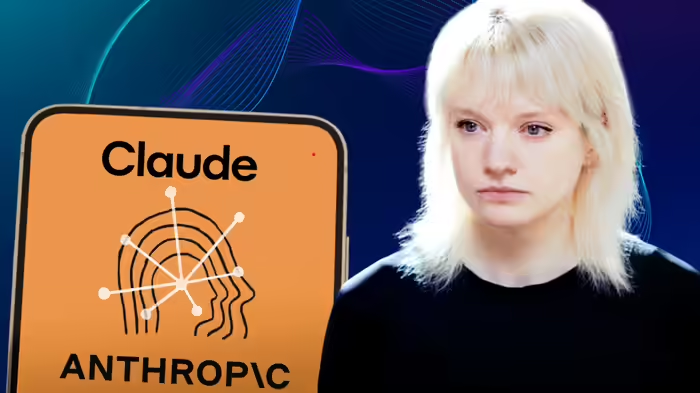
Artificial intelligence (AI) chatbots have become so advanced that they can answer nearly any question posed by humans. Yet, the credit for guiding AI to this level goes to human expertise. Among the latest efforts in ethical AI is Amanda Askell, a 37-year-old philosopher tasked with teaching Anthropic’s AI chatbot, Claude, the difference between right and wrong. From a Scottish Village to Oxford and Beyond According to reports in the Wall Street Journal, Amanda hails from a small village in Scotland. She studied at Oxford University and earned a PhD from New York University. Before joining Anthropic, she worked with OpenAI, focusing on AI safety and policy. Today, she is responsible for guiding Claude’s ethical reasoning and shaping its personality to ensure safe and helpful interac...
Chinese Developer Amazes: Robots to Get Their Own “Brain” as Alibaba Unveils AI Model RynnBrain
TECHNOLOGY

Chinese Developer Amazes: Robots to Get Their Own “Brain” as Alibaba Unveils AI Model RynnBrain

Alibaba Group Holding’s research institute, DAMO Academy, has unveiled a new open-source embodied intelligence model named RynnBrain. Built on Alibaba’s Qwen3-VL, this model is specifically designed to empower robots to perceive physical environments, reason, and execute complex tasks independently. With the rise of embodied intelligence models, Chinese tech giant Alibaba is pushing the boundaries of robotics AI. RynnBrain acts as a “brain” for robots, enabling them to move beyond pre-programmed routines and operate with cognitive autonomy. Unlike traditional AI systems that are primarily digital, RynnBrain is designed to understand, reason, and act in real-world physical environments. What Sets RynnBrain Apart According to Charlie Zheng, Chief Economist at Samoyed Cloud Technolog...
“English Will Be the Programming Language of the Future”: NVIDIA CEO Jensen Huang Explains
TECHNOLOGY

“English Will Be the Programming Language of the Future”: NVIDIA CEO Jensen Huang Explains

Jensen Huang, CEO of NVIDIA, recently stated that in the future, English will be the most powerful and effective programming language for communicating with machines. According to Huang, traditional coding may soon become outdated as users will no longer need to write code. Instead, they will simply tell systems what they need, and machines will understand and execute the instructions. Huang, who is visiting India to participate in the India AI Impact Summit 2026, emphasized that languages like C++ and Python will no longer define the future of programming. “The coder is becoming outdated,” he said. “In the future, people won’t write code on a computer. They will communicate their requirements directly to the system. If the system delivers an incorrect result, users won’t debug it—they ...
NVIDIA CEO Predicts English Will Become the Most Powerful Programming Language of the Future
TECHNOLOGY

NVIDIA CEO Predicts English Will Become the Most Powerful Programming Language of the Future

Jensen Huang, CEO of global tech giant NVIDIA, has made a striking prediction: English will become the most powerful programming language of the future, surpassing traditional coding languages like C++ and Python. According to Huang, coders may soon become “outdated,” as future systems will respond directly to natural language commands instead of written code. AI and the Future of CodingHuang is set to visit India for the India AI Impact Summit 2026, where he will share insights on artificial intelligence and its evolving role. He explained that in the future, people will no longer write code manually. Instead, they will communicate with systems in English, telling them what they need. If the system fails to deliver the correct result, users won’t debug it manually—they will simply inst...
Instagram to Introduce AI Feature for Personalized Face Swaps in Photos and Videos
TECHNOLOGY

Instagram to Introduce AI Feature for Personalized Face Swaps in Photos and Videos

Instagram is set to roll out a new AI-powered feature that will allow users to digitally insert their own faces into AI-generated photos and videos. Reports suggest that the social media giant, owned by Meta, is developing a “Face Swap” tool, which could compete with OpenAI’s Sora platform in the personalized content space. Personalized “Likeness” CreationAccording to tech tipster Alessandro Paluzzi, who shared details via X (formerly Twitter), the upcoming Instagram tool focuses on creating a personalized “likeness” rather than just applying standard image filters. While Instagram has not officially confirmed the launch, leaked screenshots indicate that the company has been working on the feature for some time. How the Face Swap Tool Will WorkThe feature, currently referred to as th...
AI Breakthrough Could Lower Costs Across Medicine, Farming, and Everyday Life
TECHNOLOGY

AI Breakthrough Could Lower Costs Across Medicine, Farming, and Everyday Life

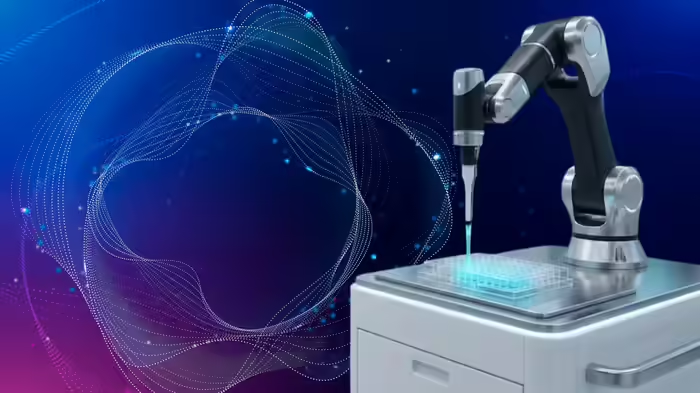
A cutting-edge AI system, GPT-5, has made the production of protein—a critical component in medicine, research, and industry—far more affordable. This breakthrough has the potential to reduce costs for everything from insulin and cancer drugs to COVID-19 tests, laboratory research, agricultural enzymes, and even household detergents. Making Protein CheaperTraditionally, producing protein requires cultivating living cells, a process that is both time-consuming and expensive. GPT-5, in collaboration with Ginkgo Bioworks, has optimized a cell-free protein synthesis (CFPS) technique, cutting overall protein production costs by up to 40% and lowering the cost of chemicals used by 57%. Instead of growing live cells, the CFPS method uses protein-producing machinery directly. GPT-5 analyzed ...