Saturday, April 11

Nation

‘Communities Strengthen, Not Divide, the Nation’: Amit Shah Responds to Critics**
Nation

‘Communities Strengthen, Not Divide, the Nation’: Amit Shah Responds to Critics**

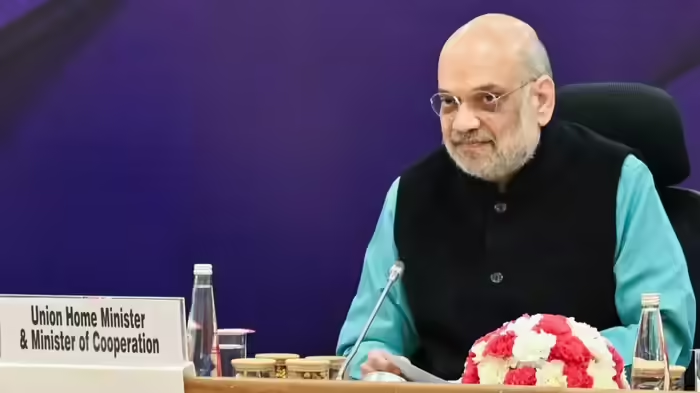
New Delhi: Union Home Minister Amit Shah on Saturday strongly defended large-scale social and community events, stating that such gatherings strengthen the nation rather than divide it. Addressing the Maheshwari Global Convention & Expo in Jodhpur, Shah emphasized that a self-reliant society paves the way for a self-reliant India. Highlighting the role of strong social and community structures, Shah said, “If each community takes responsibility for the welfare and protection of its most vulnerable members, the nation as a whole will be better positioned.” Responding to Critics Shah remarked, “Whenever social or community events are organized, some so-called progressive voices criticize the participants. I have personally faced such criticism many times. I firmly believe that t...
After Defeat in Operation Sindoor, Pakistan Forced to Make Military and Constitutional Changes: CDS Gen. Anil Chauhan Reveals
Nation

After Defeat in Operation Sindoor, Pakistan Forced to Make Military and Constitutional Changes: CDS Gen. Anil Chauhan Reveals

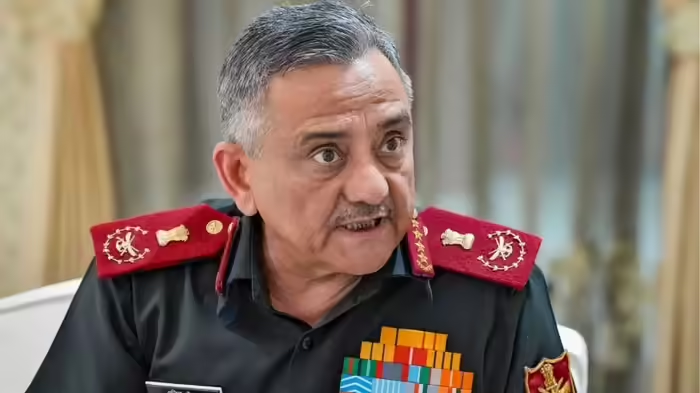
New Delhi: In the aftermath of Operation Sindoor, launched by India following terrorist attacks in Pahalgam, Pakistan faced significant setbacks, forcing it to implement both military and constitutional amendments, according to India’s Chief of Defence Staff, General Anil Chauhan. Speaking at the Pune Public Policy Festival 2026, organized by the Gokhale Institute of Politics and Economics (GIPE), Gen. Chauhan stated that the operation compelled Islamabad to restructure its higher defence organizations and make rapid constitutional changes—a clear sign that the operation did not go in Pakistan’s favour. Key Changes in Pakistan’s Military Structure Gen. Chauhan explained that Pakistan abolished the post of Chairman of the Joint Chiefs of Staff Committee and created the position of ...
Pakistan and Bangladesh Likely to Be Absent from Delhi Commonwealth Meeting Next Week
Nation

Pakistan and Bangladesh Likely to Be Absent from Delhi Commonwealth Meeting Next Week

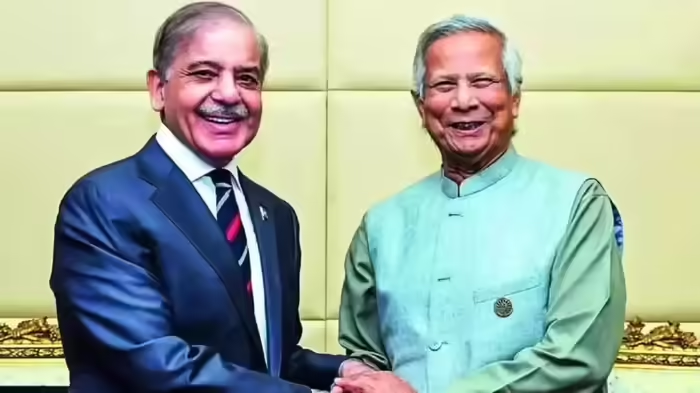
New Delhi: India will host the 28th Commonwealth Presiding Officers’ Conference (CSPOC) next week, from January 14 to 16 at the Parliament House. However, Pakistan and Bangladesh are unlikely to participate, sources say, citing regional diplomatic reasons rather than any violation of conference rules. The conference will bring together Speakers and Presiding Officers from Commonwealth nations, including Australia, Canada, Maldives, Malaysia, Sri Lanka, and the UK. Discussions will focus on strengthening democratic institutions, legislative processes, and parliamentary cooperation. Why Pakistan and Bangladesh May Skip Bangladesh’s absence is linked to the suspension of its parliament, which limits its participation in such multilateral forums. Pakistan, on the other hand, is likely...
17.82 Lakh Registrations in Just 6 Months under PMMVY: Government Deploys Facial Recognition System
Nation

17.82 Lakh Registrations in Just 6 Months under PMMVY: Government Deploys Facial Recognition System

New Delhi: The Pradhan Mantri Matru Vandana Yojana (PMMVY) has witnessed 17.82 lakh new registrations in just six months, thanks to the introduction of a facial recognition-based verification process. This system, launched on May 21, 2025, for all new enrolments, has streamlined beneficiary identification, according to the Ministry of Women and Child Development. In addition, under the Take-Home Ration scheme at Anganwadis, 4.51 crore beneficiaries out of 4.73 crore have completed their eKYC and face-matching process by December 31, 2025. Launch of “Pankhudi” Portal: A Single-Window Platform The Ministry of Women and Child Development also launched a digital portal named “Pankhudi”, aimed at creating a single-window platform for corporate social responsibility (CSR) initiatives an...
Supreme Court Urges Centre to Introduce ‘Romeo-Juliet Clause’ in POCSO Law to Prevent Misuse
Nation

Supreme Court Urges Centre to Introduce ‘Romeo-Juliet Clause’ in POCSO Law to Prevent Misuse

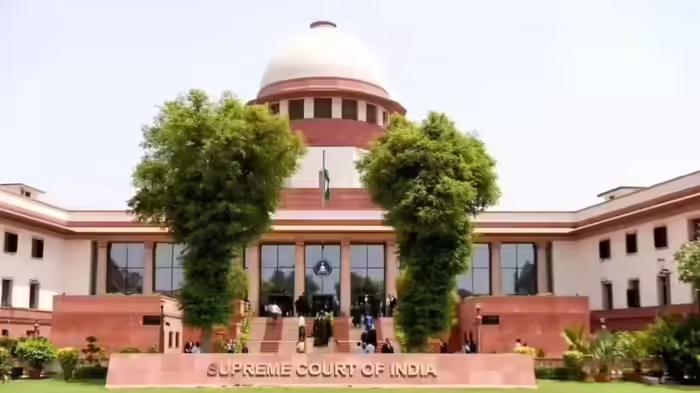
New Delhi: The Supreme Court of India has expressed concern over the misuse of the POCSO (Protection of Children from Sexual Offences) Act, which was enacted to safeguard children from sexual abuse. The Court has suggested that the central government consider introducing a ‘Romeo-Juliet Clause’ under the Act to ensure that genuine adolescent consensual relationships are not caught in the stringent provisions of the law. Supreme Court’s Observations A bench comprising Justice Sanjay Karol and Justice N. Kotishwar Singh reviewed the matter, overturning a previous Allahabad High Court order. The Supreme Court emphasized that courts cannot direct medical age verification of the victim at the time of granting bail under POCSO. The Court clarified: “The age of the victim is a matter fo...
Every Young Indian Must Carry a Fire Within, Learn from History: NSA Ajit Doval Urges Youth to Strengthen the Nation
Nation

Every Young Indian Must Carry a Fire Within, Learn from History: NSA Ajit Doval Urges Youth to Strengthen the Nation

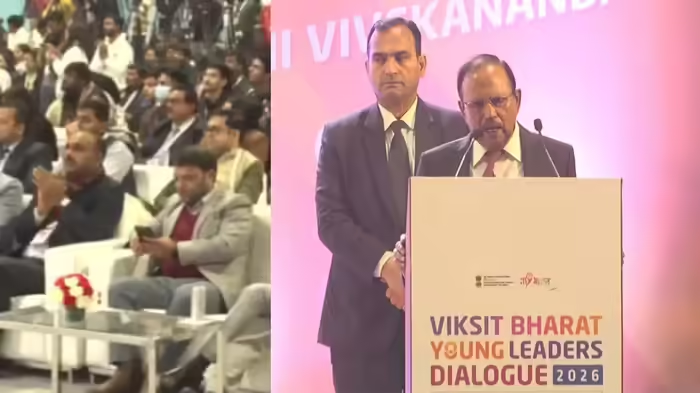
New Delhi: Speaking at the Viksit Bharat Young Leaders Dialogue, National Security Advisor (NSA) Ajit Doval appealed to India’s youth to draw inspiration from history and work toward building a stronger India. Addressing the gathering in Delhi, Doval emphasized the sacrifices of India’s forefathers, highlighting the hardships, humiliation, and losses they endured to secure the nation’s freedom. Learning from History Doval reminded the youth that independence was hard-won. Our ancestors faced severe oppression, endured public humiliation, and sacrificed greatly. Villages were burned, civilizations destroyed, and temples looted, yet the nation survived. “History challenges us today,” Doval said. “Every young Indian must carry a fire within. The word ‘revenge’ may not sound ideal, but i...
The Dark Night of Tashkent: Peace Accord or Conspiracy Against PM Lal Bahadur Shastri?
Nation

The Dark Night of Tashkent: Peace Accord or Conspiracy Against PM Lal Bahadur Shastri?

On this day, 10 January 1966, India and Pakistan signed a historic peace agreement in Tashkent, then part of the Soviet Union. The Tashkent Declaration aimed to end hostilities following the 1965 India-Pakistan war. However, just hours after the accord, India suffered a profound shock with the sudden and mysterious death of then-Prime Minister Lal Bahadur Shastri. The Tashkent DeclarationThe Tashkent peace agreement was mediated by Soviet Premier Alexei Kosygin to restore peace between the two nations after the 1965 war. Negotiations took place over six days, from 4 to 10 January 1966, in Tashkent. India was represented by Prime Minister Lal Bahadur Shastri, while Pakistan’s delegation was led by President Muhammad Ayub Khan. The agreement stipulated that both countries’ armies would...
Supreme Court Reopens ₹400 Crore Jaipur Royal Family Land Dispute
Nation

Supreme Court Reopens ₹400 Crore Jaipur Royal Family Land Dispute

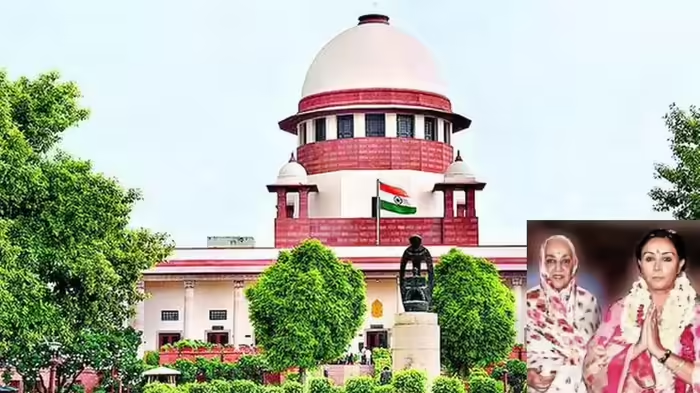
The Supreme Court has ordered a fresh hearing in a ₹400 crore land dispute between the Jaipur Development Authority (JDA) and the family of former Deputy Chief Minister and Jaipur royal member, Diya Kumari. The bench, comprising Justices J.B. Pardiwala and K.V. Vishwanathan, overturned a Rajasthan High Court decision that had upheld a lower court ruling in favor of the royal family without examining the merits. The High Court has now been directed to decide JDA’s original appeal on merit within four weeks and submit a compliance report. Background of the DisputeThe dispute concerns land in the urban area of Jaipur, historically known as Hathroi village. Today, this area includes valuable real estate, schools, hospitals, and other essential infrastructure. JDA estimates the land’s value ...
44% of Indian Cities Face Year-Round Pollution; Only 4% Covered Under NCAP, CREA Report Reveals
Nation

44% of Indian Cities Face Year-Round Pollution; Only 4% Covered Under NCAP, CREA Report Reveals

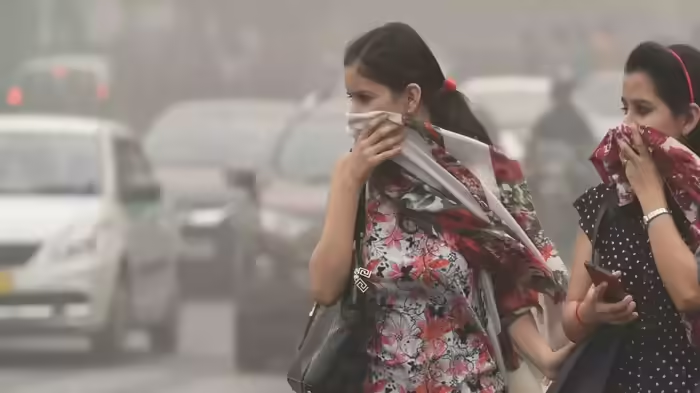
More than half of India’s cities have been struggling with air pollution for over five years. Yet, the National Clean Air Programme (NCAP) covers only a fraction of these, highlighting a significant gap in the country’s fight against air pollution. Experts emphasize the urgent need to expand NCAP’s scope and focus on pollutants like PM2.5. Year-Round PollutionAccording to a new analysis by the Centre for Research on Energy and Clean Air (CREA), only 4% of India’s most polluted cities fall under NCAP. Nearly half of the cities (44%) failed to meet PM2.5 standards consistently for five or more years. This indicates that air pollution is not a seasonal issue but a year-long challenge, driven by continuous emissions from transport, industry, and power plants. CREA’s study, based on satel...
AI and Space Science Promise Breakthroughs: LLMs May Help Solve Unanswered Questions
Nation

AI and Space Science Promise Breakthroughs: LLMs May Help Solve Unanswered Questions

The world of science and technology is witnessing transformative developments. From the possible discovery of a ninth planet in our solar system to artificial intelligence (AI)-driven scientific breakthroughs, the coming months could bring unprecedented progress. Advances in solar energy, carbon emission reduction, self-healing infrastructure, and ambitious space missions are set to redefine the scientific landscape. A Ninth Planet?After Pluto lost its planetary status, Neptune remained the outermost recognized planet. However, in late December 2025, Japanese astronomers using infrared imaging from satellites (taken in 1983 and 2006) reported an object that appeared to have shifted position over 23 years. Estimated to be 7–17 times the mass of Earth, this icy body could potentially be t...