Sunday, December 21

Business

Stocks to Watch: Anant Raj, Hindustan Zinc Lead Gains; Bullish Signals on Dalal Street
Business

Stocks to Watch: Anant Raj, Hindustan Zinc Lead Gains; Bullish Signals on Dalal Street

New Delhi: Domestic stock markets continued their upward momentum on Friday, marking a second consecutive day of gains. Positive global cues and strong buying in metal stocks propelled both key indices higher. The BSE Sensex rose 449.53 points, or 0.53%, closing at 85,267.66, after touching an intraday high of 85,320.82. The NSE Nifty advanced 148.40 points, or 0.57%, to finish at 26,046.95, reclaiming the 26,000 level. Among Sensex constituents, shares of Tata Steel, Eternal, UltraTech Cement, L&T, Maruti, and Bharti Airtel closed higher. In contrast, Hindustan Unilever, Sun Pharma, ITC, and Asian Paints saw declines. Stocks Showing Strong BuyingInvestors showed strong interest in Transformers & Rectifiers, Anant Raj, Hindustan Zinc, Hindustan Copper, GMR Airports, Choice...
Climate Protection Bill: India Faces $200 Billion Annual Cost by 2050 to Counter 2°C Warming
Business

Climate Protection Bill: India Faces $200 Billion Annual Cost by 2050 to Counter 2°C Warming

New Delhi: The threat of climate change has intensified, demanding urgent and large-scale action in India. A new report by McKinsey Global Institute warns that if global temperatures rise by 2°C, India—and the broader China region—will need to spend over $200 billion annually (around ₹18.6 lakh crore) by 2050 on climate protection. Currently, India spends just $15 billion (≈₹1.3 lakh crore), covering only 13% of the required expenditure, leaving most of its population exposed to heatwaves, floods, droughts, and other climate hazards. The report, Advancing Adaptation: Mapping Costs from Cooling to Coastal Defense, provides a detailed analysis of the costs required to protect against climate-related risks. Globally, 4.1 billion people face climate threats, yet only 1.2 billion have adequa...
Stock Market Performance: Triple Factors Create Volatility, India Lags Behind Asia
Business

Stock Market Performance: Triple Factors Create Volatility, India Lags Behind Asia

New Delhi: December has seen increased volatility in the Indian stock market, driven by a trio of concerns that have spooked foreign investors. According to market analysts, Foreign Institutional Investors (FIIs) have intensified their selling compared to November, primarily due to the delay in the US-India trade agreement, a rising trade deficit, and negative sentiment surrounding Russian President Vladimir Putin’s recent visit to India. Asian markets have also experienced profit-taking, which has weighed on India’s performance. FIIs are securing gains after strong returns in markets such as China, Japan, South Korea, and Taiwan in 2025. The Nikkei, Hang Seng, KOSPI, and Shanghai indices have delivered dollar returns of 27.5%, 29.5%, 73.7%, and 16% respectively so far this year. A k...
Jefferies Report: Putin’s Visit Reinforces India’s Independent Foreign Policy, Focuses on Deals, Not Pawns
Business

Jefferies Report: Putin’s Visit Reinforces India’s Independent Foreign Policy, Focuses on Deals, Not Pawns

New Delhi: Russian President Vladimir Putin’s recent visit to India has underscored the country’s commitment to an independent and balanced foreign policy. According to a report by global brokerage firm Jefferies, India will not yield to pressure from any major power, reaffirming its “strategic autonomy” on the world stage. Jefferies’ Global Head of Equity Strategy, Christopher Wood, highlighted that the visit does not imply Delhi’s alignment with Moscow. Instead, it exemplifies India’s multi-alignment approach, maintaining strong relations with Western nations, Russia, and China while staying clear of bloc politics. The focus remains firmly on practical partnerships and business deals, signaling the Modi government’s intent to boost investments. Wood emphasized in his weekly newslet...
India’s Largest Government Bank Cuts Loan Rates: How Much Will Your EMI Drop?
Business

India’s Largest Government Bank Cuts Loan Rates: How Much Will Your EMI Drop?

New Delhi: Following the recent 25 basis points cut in the repo rate by the Reserve Bank of India (RBI), the country’s largest government bank, State Bank of India (SBI), has reduced interest rates across its loan portfolio. The move is expected to make borrowing cheaper for both retail and corporate customers, resulting in lower EMIs. SBI Reduces Key Lending RatesSBI has cut interest rates on all its major loan benchmarks, including MCLR (Marginal Cost of Funds-Based Lending Rate), EBLR (External Benchmark Lending Rate), and RLLR (Repo-Linked Lending Rate). The bank has also revised its BPLR and base rates, ensuring that the recent RBI rate cut benefits borrowers immediately. Here’s how MCLR rates have changed: Overnight & 1-month MCLR: 7.90% → 7.85% 3-month MCLR: 8.30% →...
No Diwali Holiday in 2026 Stock Market Calendar: Key Trading Closures Announced
Business

No Diwali Holiday in 2026 Stock Market Calendar: Key Trading Closures Announced

The National Stock Exchange (NSE) has released the official trading holiday calendar for 2026, revealing a notable surprise for investors: there will be no full market closure on Diwali, as the festival falls on a Sunday this year. For traders and market participants, knowing the holiday schedule is crucial for portfolio planning, derivatives strategies, and liquidity management. 2026 Trading Holidays Overview In 2026, equity, equity derivatives, and currency derivatives markets will remain closed for a total of 15 days. Key holidays include: 26 January: Republic Day 3 March: Holi 26 March: Ram Navami 31 March: Mahavir Jayanti 3 April: Good Friday 14 April: Ambedkar Jayanti 1 May: Maharashtra Day 28 May: Bakri-Eid Other notable closures are: 26 June: ...
China Surpasses $1 Trillion Trade Surplus: Lessons for India Amid Global Shifts
Business

China Surpasses $1 Trillion Trade Surplus: Lessons for India Amid Global Shifts

China has emerged as the world’s leading trading powerhouse, reaching an unprecedented $1 trillion trade surplus for the first time in history. Despite U.S. tariffs under former President Donald Trump, China has demonstrated remarkable resilience, expanding exports to multiple global markets and securing its dominance as the top trading partner for 80 countries, including India. From Parity to Global Leadership In the early 1990s, India and China had comparable economies and per capita incomes. Today, China’s economy is nearly four times larger than India’s, with per capita income far higher. Over the past three decades, China has transformed from a low-income agrarian society into the world’s second-largest economy, leveraging industrial policy, mass manufacturing, and export-led gr...
Stock Market Winners and Losers: How Investors Fared Over the Past Five Years
Business

Stock Market Winners and Losers: How Investors Fared Over the Past Five Years

The period from 2020 to 2025 proved to be one of the most lucrative five-year spans in India’s stock market history, generating substantial wealth for investors. However, it was also a time of significant losses for some, highlighting the high-risk, high-reward nature of equities. Top Wealth Creators According to a recent study by Motilal Oswal, India’s top 100 wealth-creating companies delivered exceptional returns, achieving a compound annual growth rate (CAGR) of 38%—well above the Sensex’s 21% CAGR during the same period. Leading the pack was Bharti Airtel, which added ₹7.9 lakh crore to its market value over five years. ICICI Bank followed closely with a market value increase of ₹7.4 lakh crore. The Bombay Stock Exchange (BSE) itself was among the fastest wealth creators, del...
Post Offices to Offer Mutual Fund Investment Facilities in Villages and Towns
Business

Post Offices to Offer Mutual Fund Investment Facilities in Villages and Towns

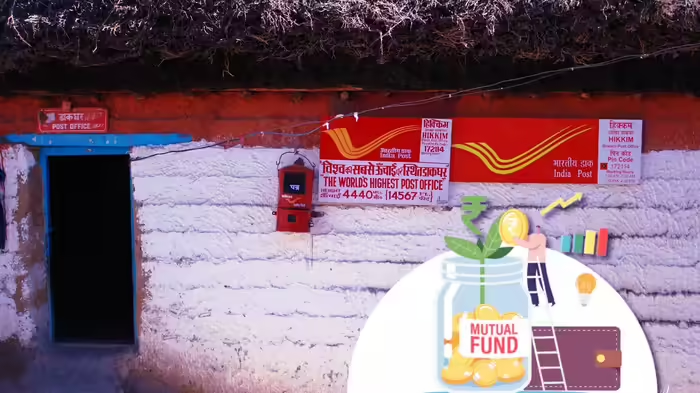
In a landmark initiative aimed at expanding financial inclusion, India’s rural and semi-urban population can now invest in mutual funds directly through post offices. The move comes after the Bombay Stock Exchange (BSE) signed a Memorandum of Understanding (MoU) with the Department of Posts on Friday, enabling millions of people in Tier-2 and Tier-3 towns to access mutual fund investment opportunities. Bringing Mutual Funds Closer to Rural India Traditionally, the benefits of the stock market and mutual fund investments have been largely restricted to urban populations. Rural participation has been limited due to lack of awareness and access. With this partnership, post offices—India’s most extensive physical network—will act as distributors of mutual fund products, helping bridge th...
Bridging the Wealth Gap: How Life for India’s Poor Has Improved Over the Last Decade
Business

Bridging the Wealth Gap: How Life for India’s Poor Has Improved Over the Last Decade

Bridging the Wealth Gap: How Life for India’s Poor Has Improved Over the Last Decade While India’s richest 1% still hold nearly 40% of the nation’s wealth, recent data shows that the gap between the rich and the poor has narrowed in several key aspects over the past decade. The country’s rapid economic growth and targeted policy interventions have enabled millions of lower-income households to access goods and services that were once considered luxuries. Vehicles in Rural and Urban Households About ten years ago, fewer than one in ten of India’s poorest rural families owned a bicycle, scooter, or car. Today, nearly half of these households have at least one vehicle. Urban areas show an even higher rate of vehicle ownership. Comparing the top 20% and bottom 40% of households by veh...