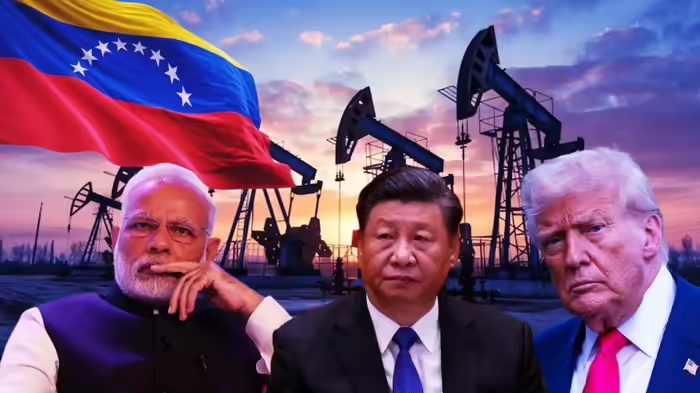
New Delhi: The ongoing political upheaval in Venezuela has thrown China-Venezuela oil and finance deals into uncertainty, raising questions about the repayment of billions in loans. Following the ouster of President Nicolás Maduro, the future of the landmark oil-for-loan partnership between Beijing and Caracas has become increasingly precarious.
China’s $10 Billion at Risk
In the early 2000s, as China’s economy surged, it sought secure oil supplies, while Venezuela under Hugo Chávez sought to reduce dependence on the U.S. This led to a historic deal in which China committed over $100 billion in loans in exchange for Venezuelan oil. These funds financed critical infrastructure projects, including railways and power plants, while Venezuela repaid China in oil shipments.
Over the years, Venezuela struggled to meet its obligations. Currently, approximately $10 billion remains unpaid to China, exacerbated by plummeting oil prices and Venezuela’s prolonged economic crisis. AidData estimates that from 2000 to 2025, China extended $106 billion in loans to Venezuela, making it the largest creditor. U.S. sanctions imposed in 2017 further complicated Beijing’s ability to reclaim funds.
India’s $1 Billion Exposure
India also has significant exposure in Venezuela, though comparatively smaller. ONGC Videsh Limited (OVL) has roughly $1 billion (₹9,000 crore) at stake, linked to its 40% stake in the San Cristóbal oil field. Of this, $53.6 million dates back to 2014, with an equal amount pending for subsequent years. U.S. sanctions and political instability have delayed both payments and oil production for several years.
Trump Administration’s Intervention
The recent capture of Nicolás Maduro by U.S. forces, under directives from former President Donald Trump, has further disrupted the Venezuelan oil sector. Trump announced that the U.S. is prepared to take control of Venezuela’s oil industry. U.S. Secretary of State Marco Rubio stated that American forces would block tankers linked to sanctioned entities until Venezuela opens its state-run oil industry for foreign investment, presenting both opportunities and challenges for creditor nations.
Shifts in China’s Energy Strategy
While China remains a major fossil fuel consumer, it has shifted investments toward renewable energy, including solar and electric vehicles. These strategic moves, coupled with U.S. interventions in Venezuela, create both hurdles and potential pathways for Beijing to recover its loans—though American involvement in Latin America complicates matters further.
Conclusion: The Venezuela crisis underscores the fragility of international oil-for-loan agreements. With China’s $10 billion exposure and India’s $1 billion stake entangled amid sanctions, political instability, and U.S. intervention, the repayment and future of these investments remain highly uncertain.
Discover more from SD NEWS agency
Subscribe to get the latest posts sent to your email.