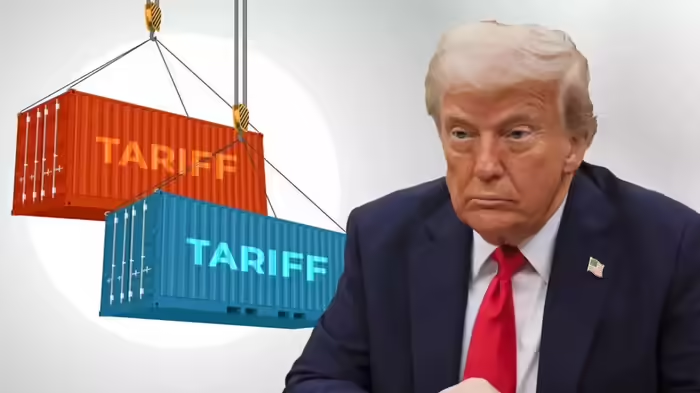
Supreme Court Strikes Down Trump’s Tariffs: Last Friday proved challenging for U.S. President Donald Trump as the Supreme Court declared his previously imposed global tariffs illegal. In response, the Trump administration rolled out a new temporary 15% global tariff, effective immediately but valid for just 150 days.
Who Benefits the Most?
According to an independent research group, Global Trade Alert, the court’s ruling combined with the uniform 15% tariff will significantly reduce effective tariff rates for several countries. Brazil, China, and India emerge as the biggest beneficiaries:
- Brazil – tariff rates drop by 13.6%
- China – tariff rates drop by 7.1%
- India – tariff rates drop by approximately 6%
These reductions come despite President Trump’s repeated criticisms and heavy tariff impositions on these countries in the past.
Background: Trump’s Tariff Measures
Last year, Trump invoked the International Emergency Economic Powers Act (IEEPA) to impose tariffs on key U.S. trading partners. The Supreme Court’s recent verdict invalidated these actions. Following the ruling, Trump announced a 10% global flat-rate tariff, which he quickly increased to 15% on Saturday. These new tariffs are temporary and will require further Congressional review after 150 days.
Why These Countries Are Sensitive to Trump
Throughout his tenure, Trump frequently targeted India, China, and Brazil with tariffs, arguing that they manipulated currency and trade practices to disadvantage American businesses. Brazil faced tariffs as high as 50%, China and India were also subjected to similar punitive measures. These countries now stand to gain from the court-mandated recalibration of U.S. tariffs.
Future Uncertainty
Despite the current relief for India, China, and Brazil, future tariff policies remain uncertain. The Trump administration has indicated that it may pursue country-specific additional measures under Section 301 of the Trade Act of 1974, leaving the global trade environment in a state of flux.
Discover more from SD NEWS agency
Subscribe to get the latest posts sent to your email.