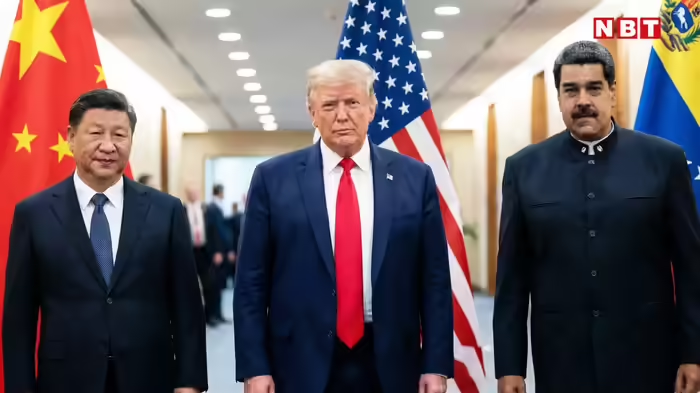
The United States has taken control of Venezuela’s oil resources and recently sold a portion of its crude, disrupting China’s longstanding strategy in the South American nation. In recent years, Venezuela had emerged as China’s largest strategic partner in the region.
US Intervention in Venezuela
The US has reportedly arrested Venezuelan President Nicolás Maduro, asserting control over the country’s oil exports. Venezuela holds the world’s largest proven oil reserves, estimated at around $303 billion in crude, valued at approximately $15 trillion. China had long entangled Venezuela in a debt-for-oil arrangement, receiving crude oil in exchange for loans. With the US now controlling Venezuelan exports, crude oil previously earmarked to repay Chinese loans is being redirected elsewhere. Until recently, China was the largest buyer of Venezuelan oil.
Strategic Ties Between China and Venezuela
In recent decades, Venezuela had become a close strategic ally of China in Latin America. According to the US-China Economic and Security Review Commission, both countries had developed deep cooperation in energy, finance, military, and space sectors. Their relationship strengthened steadily from the late 1990s. In 2023, it was elevated to an “All-Weather Strategic Partnership.” Despite US sanctions, the two nations maintained long-standing ties.
China’s Debt Exposure
Questions now arise about the extent of China’s loans to Venezuela and how repayments were managed. Accurate figures are difficult to obtain, particularly after 2017, when US sanctions halted Venezuela’s debt payments. According to AidData, a research lab at the College of William & Mary, Chinese state banks provided $106 billion in loans to Venezuela between 2000 and 2018. By 2017, approximately $44 billion remained outstanding. Current estimates vary: some institutions suggest China’s remaining exposure is around $10 billion, while JPMorgan estimates total debt between $13–15 billion. It remains unclear whether Venezuela has repaid any principal since the 2017 default or only the interest.
How the Debt-for-Oil Arrangement Worked
Sources from Venezuela’s state oil company, PDVSA, indicate that in 2019 China granted Venezuela some leeway on principal repayment. In exchange, Venezuela repaid a portion of its debt through shipments of crude and fuel oil. Internal PDVSA documents reveal that 642,000 barrels of crude and fuel oil were sent to China daily, with a fraction directed toward debt repayment. Some of the proceeds from these sales were deposited into an account controlled by Beijing, from which the debt was serviced.
Venezuela has historically not disclosed reliable figures for its national debt. The central bank last released data in 2019. Since then, determining the exact debt level or whether new loans have been taken has become difficult. Following US sanctions, China and Russia remained Venezuela’s primary allies, with most government debt owed to China.
Discover more from SD NEWS agency
Subscribe to get the latest posts sent to your email.