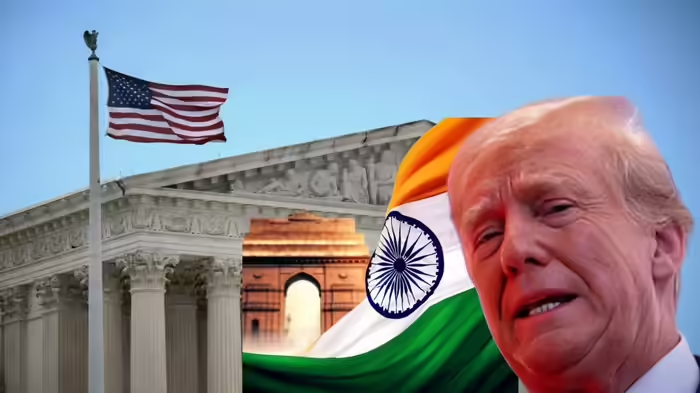
New Delhi: The U.S. Supreme Court has delivered a major blow to former President Donald Trump’s tariff regime, declaring it illegal and sharply limiting presidential authority to impose unilateral trade tariffs. In a 6-3 ruling, the Court clarified that the International Emergency Economic Powers Act (IEEPA) of 1977 does not grant the President the power to levy tariffs. The law only allows regulation or restriction of certain international transactions during a national emergency.
The verdict strikes at the heart of Trump’s aggressive trade strategy, which affected countries including India, China, Canada, Mexico, Brazil, and several others, subjecting them to high reciprocal tariffs.
Why This Ruling is a Major Setback
The Trump administration argued that IEEPA’s provisions allowed the President to regulate imports during a declared national emergency. Critics contended that the law never authorized unilateral, large-scale tariffs on any country at any time. Both a federal trade court and a federal appellate court had previously supported this interpretation before the matter reached the Supreme Court.
IEEPA-based tariffs accounted for a significant portion of U.S. tariff revenue last year. The Supreme Court’s decision directly challenges a central pillar of Trump’s trade framework.
Impact on India
From India’s perspective, the ruling could have multiple positive effects:
- Indian exporters affected by the high tariffs will no longer face additional financial burdens.
- The recent interim India-U.S. trade deal, which lowered tariffs to 18%, now positions India more favorably in negotiations.
- The Court ruling limits U.S. authority to impose punitive measures on India, including sanctions related to Russian crude oil imports.
- Most importantly, the verdict reduces uncertainty by confirming that Congress—not the President—holds the authority to levy tariffs, lowering the risk of sudden trade sanctions in the future.
Uncertainty Over Refunds
It remains unclear whether businesses or consumers will receive refunds for tariffs already collected under IEEPA. Some economists suggest that companies may seek compensation through legal channels, while direct payments to consumers could require Congressional action, despite Trump’s prior proposal of $2,000 “dividend” checks.
Potential for Further Litigation
According to Moody’s Chief Economist Mark Zandi, if the Supreme Court does not provide further guidance and the administration fails to offer compensation, significant legal actions by businesses are likely, ultimately requiring judicial resolution.
Trump’s Warning
Trump had positioned tariffs as both leverage and a lifeline—aimed at securing concessions on trade, immigration, drug enforcement, and military issues. He claimed tariffs could ultimately offset income taxes and even proposed $2,000 tariff “dividend” checks for Americans. On January 12, he warned via social media that a court reversal could lead to “economic disaster,” framing the issue as one of “life and death.”
Effect on Consumer Costs
Economists note that tariffs had already increased prices on imported goods, including furniture, clothing, food, electronics, and vehicles, costing an average U.S. household approximately $1,000 in 2025. For 2026, this additional burden was projected to rise to $1,300–$1,700. With IEEPA tariffs now struck down, analysts estimate that domestic costs could drop by roughly $600–$800 next year, although prices are unlikely to return fully to pre-2025 levels due to other ongoing tariffs imposed under different laws.
Are Legal Avenues Still Open for Trump?
The Trump administration has indicated it may explore other statutory authorities, including Section 232 of the Trade Expansion Act, to maintain parts of its tariff framework. Treasury Secretary Scott Bassent confirmed that alternative legal mechanisms exist if IEEPA-based tariffs are invalidated, though Trump contends that none are as straightforward or powerful.
The Supreme Court decision marks a pivotal moment for global trade, reducing uncertainty for exporters and recalibrating U.S. trade policy authority.
Discover more from SD NEWS agency
Subscribe to get the latest posts sent to your email.