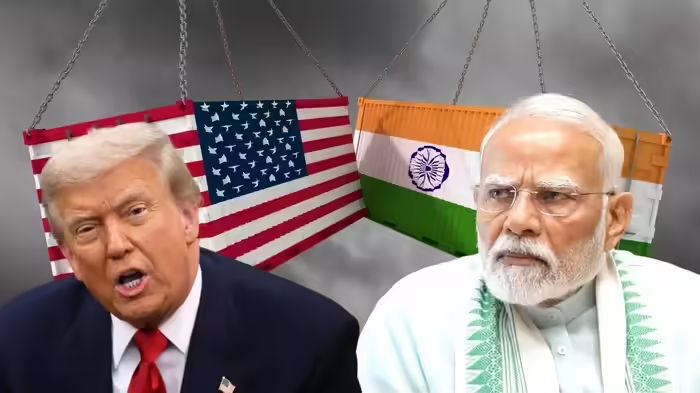
New Delhi: U.S. President Donald Trump has announced a new tariff policy that could have far-reaching implications for India. Trump declared that any country trading with Iran will face a 25% tariff on trade with the United States, a move that could push India’s total tariffs to a staggering 575%.
How India Is Affected
Currently, India already faces a 50% tariff from the U.S.—half of which is reciprocal and the other half imposed as a penalty for importing crude oil from Russia. Under Trump’s latest announcement, an additional 25% tariff could apply due to India’s trade with Iran. Combined with the 50% and potential 500% tariffs linked to Russia, this could escalate India’s total trade duties with the U.S. to 575%, creating major concerns for exporters and policymakers.
India-Iran Trade Relations
India and Iran share a long-standing trade relationship. According to the Indian Ministry of External Affairs, India ranks among Iran’s top five trading partners. Key exports from India include rice, tea, sugar, pharmaceuticals, artificial fibers, electrical machinery, and imitation jewelry, while imports from Iran include dry fruits, inorganic/organic chemicals, and glassware.
In October 2025, India exported $56.1 million worth of goods to Iran and imported $28.3 million, yielding a trade surplus of $27.9 million. However, compared to October 2024, India’s exports to Iran fell by 29% (from $79.1 million to $56.1 million), primarily due to a sharp decline in Basmati rice exports, which dropped $26.6 million (54.6%). Exports of glass and glassware fell $2.77 million (93.1%) and other engineering goods declined $925,000 (88.2%).
Strategic Importance of Chabahar Port
From a trade and strategic perspective, Iran’s Chabahar port is vital for India. The port serves as a critical corridor to Afghanistan and Central Asia, bypassing Pakistan. Last year, the U.S. extended a six-month exemption on sanctions related to Chabahar until April, after having previously revoked it in September 2025. This exemption, in place since 2018, allowed India to develop Chabahar as a key trade route.
If the exemption is revoked again, companies involved in operating or using Chabahar could face penalties under the U.S. Iran Freedom and Counter-Proliferation Act. The port’s strategic significance has increased with India’s gradually improving ties with Afghanistan, particularly as engagement with the Taliban administration in Kabul becomes more constructive.
Trump’s latest tariff directive has sparked concern in India’s trade circles, raising questions about the impact on exports, ongoing investments, and strategic projects tied to Iran.
Discover more from SD NEWS agency
Subscribe to get the latest posts sent to your email.