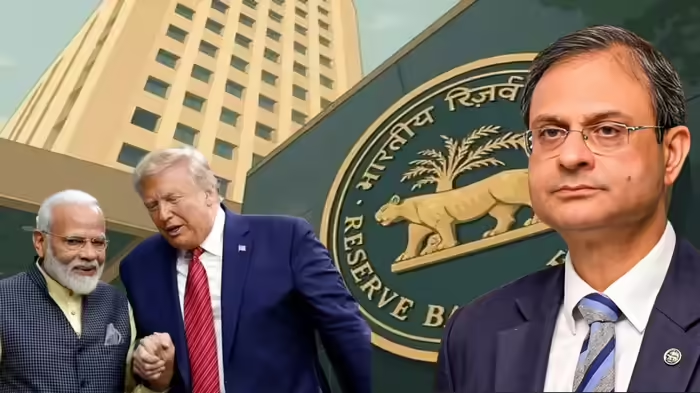
New Delhi: The Reserve Bank of India (RBI) on Friday decided to keep its key policy rate unchanged, maintaining the repo rate at 5.25%, despite widespread expectations of further easing. The central bank’s decision comes at a time when India’s economic outlook has strengthened, particularly after major trade developments with the United States and the European Union (EU).
The RBI also retained its monetary policy stance as “neutral”, signalling that interest rates may remain stable for an extended period, and any future move will depend on incoming inflation and growth data.
Why RBI Did Not Cut Interest Rates
RBI Governor Sanjay Malhotra, while announcing the monetary policy decision, said that external challenges have increased, but India’s domestic fundamentals remain strong. He highlighted that inflation continues to stay below the tolerance band and the outlook remains favourable.
Governor Malhotra noted that despite global uncertainty, India is witnessing strong growth momentum along with controlled inflation, placing the economy in a relatively comfortable position.
“Inflation remains below the tolerance band and its outlook is soft. High-frequency indicators suggest that strong growth momentum is likely to continue through Q3 of FY 2025-26 and beyond,” the Governor stated.
India-US Deal Reduced Tariff Pressure
A major factor supporting the RBI’s pause is the recent breakthrough in the India-US trade agreement. Earlier this week, US President Donald Trump announced that Washington and New Delhi had reached a key understanding that would reportedly reduce US tariffs on Indian goods from 50% to 18%.
This move is expected to reduce trade-related stress on the Indian economy, strengthen exports, and ease inflationary pressures that could have emerged from higher global tariffs.
The RBI indicated that the successful conclusion of this trade agreement is a positive signal for the Indian economy and helps improve long-term growth prospects.
EU Trade Agreement Adds Further Confidence
The Governor also referred to India’s historic trade deal with the European Union, stating that such agreements will help sustain growth for a longer duration. These international developments provide stability and reduce the need for aggressive monetary easing.
Global Uncertainty Still a Risk
While the RBI acknowledged improved global growth prospects supported by investment and fiscal stimulus, it also warned that rising geopolitical tensions and trade frictions are disturbing the global economic order.
The Governor pointed out that inflation trends vary widely across regions, with most major developed economies still facing inflation levels above targets. This has led to varied monetary policy actions worldwide, as many central banks approach the end of their easing cycles.
Experts Decode RBI’s Move
Economists believe the RBI’s decision reflects a strategy of maintaining stability while monitoring the impact of earlier rate cuts.
Sakshi Gupta, Principal Economist at HDFC Bank, said that the RBI could be entering a long pause phase.
“We may see an extended pause in policy rates ahead. The 5.25% repo rate could be seen as the terminal rate. RBI has reiterated its commitment to provide sufficient liquidity for effective transmission,” she said.
She further added that given the liquidity already infused in recent weeks, there may not be a need for additional liquidity measures in the fourth quarter of FY 2025-26.
Meanwhile, Garima Kapoor, Economist at Elara Securities (Institutional Equities), said that the RBI’s Monetary Policy Committee (MPC) is focusing on ensuring the full transmission of previous rate cuts, while keeping a close watch on inflation risks.
She warned that inflation may rise due to normalisation in food prices and base effects, limiting the scope for further rate cuts.
“Only a major shock in the growth-inflation balance could push RBI towards another cut. For now, we expect a prolonged pause,” Kapoor added.
Outlook
With inflation currently under control, strong growth indicators, and the India-US trade deal easing tariff pressures, the RBI appears comfortable maintaining its current policy stance. Analysts believe the central bank is now likely to hold rates steady for the coming months, unless inflation spikes or growth weakens unexpectedly.
Discover more from SD NEWS agency
Subscribe to get the latest posts sent to your email.