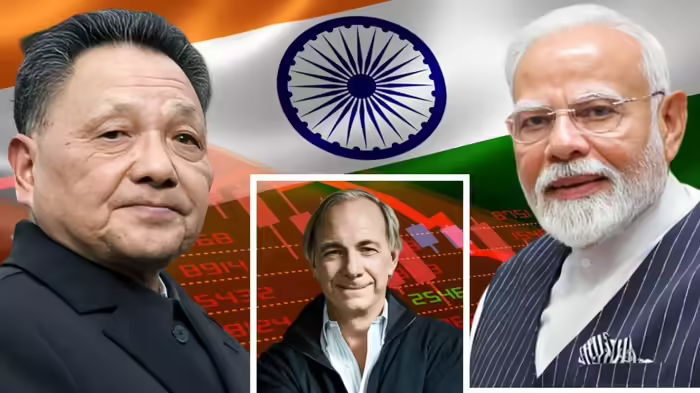
New Delhi: India’s economy is currently on a rapid growth trajectory, attracting global attention. The country is on track to become a $5 trillion economy in the near future. Highlighting this remarkable growth, Raymond Thomas Dalio, the American billionaire, investor, and founder of Bridgewater Associates—commonly known as Ray Dalio—praised Prime Minister Narendra Modi for his economic leadership.
In a conversation with Indian entrepreneur Nikhil Kamath, Dalio stated that India, despite its challenges, is poised to become one of the fastest-growing major economies over the next decade. He drew a comparison between PM Modi and Deng Xiaoping, the Chinese leader credited with ushering China into a market-oriented economy and widely regarded as the architect of modern China’s economic reforms.
The Basis of the Comparison
Dalio clarified that the comparison was not ideological but structural. He said Modi, like Deng, has demonstrated the ability to implement long-term, transformative reforms. Strategic investments in infrastructure, logistics, digital systems, and financial frameworks, Dalio explained, create sustained growth rather than short-lived economic spurts. He noted that such reforms position India at the early stage of a multi-decade growth cycle, similar to where China stood nearly 30 years ago.
A Word of Caution
Despite his optimism, Dalio warned that strong economic momentum does not automatically translate into global dominance. He emphasized that India’s global influence still lags behind that of the United States and China. This underscores the distinction between economic growth and geopolitical power. Dalio suggested that India must continuously convert its domestic strengths and reforms into strategic capabilities to bridge this gap.
Changing Global Rules
Dalio also highlighted a major shift in the post-1945 global order. “We no longer have the world system built solely on international institutions like the UN, WTO, or World Bank,” he said. Instead, power and influence increasingly determine global outcomes. With rising geopolitical fragmentation and declining trust among major powers, nations are preparing to compete not just on battlefields but also in trade, capital flows, technology, and spheres of influence.
Discover more from SD NEWS agency
Subscribe to get the latest posts sent to your email.