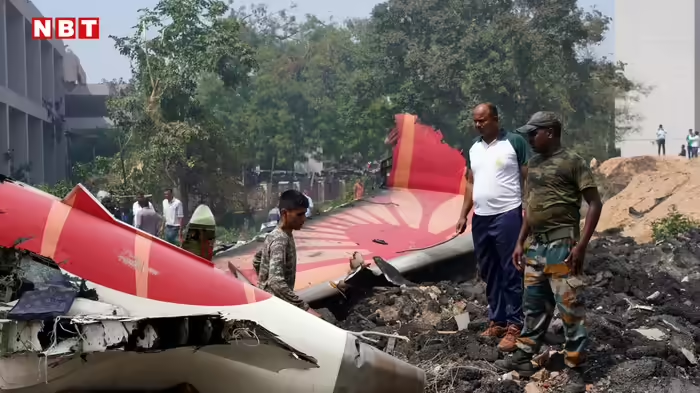
A new development has emerged in the ongoing investigation of the Air India Boeing 787 crash. An American aviation safety group claims that the aircraft involved had a history of technical failures, raising questions about whether these issues contributed to last year’s tragic accident.
Crash Details
The Boeing 787, operated by Air India, crashed on 12 June 2025, shortly after departing from Ahmedabad Airport en route to London. The disaster claimed the lives of 260 passengers and crew members. The official investigation is still underway.
Technical Failures Highlighted
According to the Aviation Safety Foundation (FAS), the aircraft had experienced multiple technical issues even before entering Air India’s service. The group submitted its findings to the US Senate Permanent Subcommittee on Investigations, citing internal documents.
The report alleges persistent system failures, including recurring electronics and software malfunctions, tripping circuit breakers, faulty wiring, short circuits, intermittent power supply, and overheating of critical power system components.
A particularly serious incident occurred in January 2022, when the aircraft’s P100 power distribution panel caught fire while landing at Frankfurt Airport. The panel, one of five distributing high-voltage electricity from the engines throughout the aircraft, had to be completely replaced due to the damage.
Electrical Dependence of the 787
Compared to previous-generation aircraft, the Boeing 787 relies heavily on electrical systems. Early in its operational history, the 787 faced safety issues, including battery fires in a 2013 Japan Airlines aircraft, which led to a temporary grounding of the model globally. The P100 panel was redesigned after a 2010 test-plane fire, highlighting a history of power-related concerns.
India’s Investigation
In India, the Aircraft Accident Investigation Bureau (AAIB) is leading the probe, with US officials involved since the aircraft and engines were designed and manufactured in the United States. The preliminary AAIB report released a month after the crash indicated that the fuel control switch was moved from ‘Run’ to ‘Cut-off’ shortly after takeoff, cutting off fuel to the engines. Cockpit voice recordings suggest confusion among pilots over who operated the switch, raising questions about whether the crash resulted from pilot error or technical malfunction.
Victims’ lawyers, aviation safety advocates, pilot groups, and technical experts caution against focusing solely on pilot actions, noting that underlying technical failures may have been the root cause.
Discover more from SD NEWS agency
Subscribe to get the latest posts sent to your email.