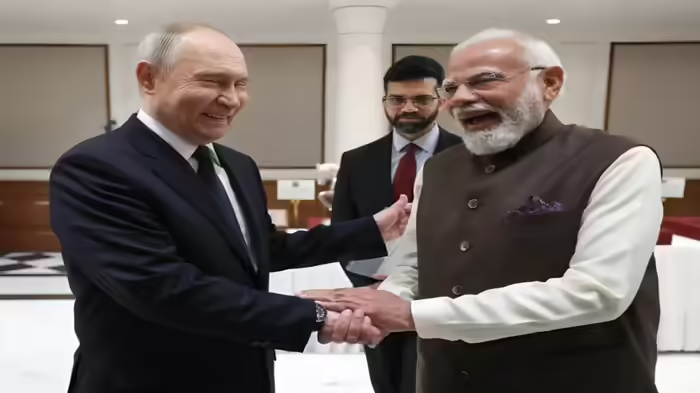
New Delhi: Russian President Vladimir Putin’s recent visit to India has underscored the country’s commitment to an independent and balanced foreign policy. According to a report by global brokerage firm Jefferies, India will not yield to pressure from any major power, reaffirming its “strategic autonomy” on the world stage.
Jefferies’ Global Head of Equity Strategy, Christopher Wood, highlighted that the visit does not imply Delhi’s alignment with Moscow. Instead, it exemplifies India’s multi-alignment approach, maintaining strong relations with Western nations, Russia, and China while staying clear of bloc politics. The focus remains firmly on practical partnerships and business deals, signaling the Modi government’s intent to boost investments.
Wood emphasized in his weekly newsletter, Greed & Fear, that India refuses to be a pawn in the rivalries of major powers. During the visit, the spirit of partnership was evident, with a pragmatic approach taking precedence over ideological alignment, even amidst differing perspectives on the Ukraine conflict.
The visit marked the 23rd India-Russia Annual Summit, where Prime Minister Narendra Modi and President Putin celebrated 25 years of strategic partnership established in 2000. The leaders described the relationship as “time-tested,” based on mutual trust and respect for each other’s core interests.
India maintained a clear stance on the Ukraine conflict, reiterating the call for an immediate end to the war through diplomacy and dialogue, and offering its support as a mediator. This strengthened India’s position as a balanced voice of the Global South.
On the economic and strategic front, both countries emphasized a contemporary, balanced, and mutually beneficial partnership, covering trade, defense cooperation, and energy security. Despite Western sanctions, India continues to purchase Russian oil at concessional rates. The joint statement underscored shared responsibilities as major powers, pledging to enhance cooperation in defense, space, nuclear energy, and trade. The summit also aimed to diversify collaboration into emerging sectors such as AI, green technologies, and Arctic exploration, beyond the existing $65 billion bilateral trade in 2024-25.
Wood notes that India’s approach aligns with its “multi-alignment” policy, engaging with all major global powers rather than forming exclusive alliances. The visit follows India’s G20 presidency in 2023 and efforts to expand BRICS, further strengthening its global position.
While some critics in the US and Europe may perceive India’s stance as soft, it reflects a strategic focus on the interests of its 1.4 billion citizens, including affordable energy, food security, and technology transfer. Putin praised India’s “unity in diversity,” presenting it as a model for larger nations.
This visit demonstrated India’s diplomatic strength: non-aligned, firm in its autonomy, and unwilling to be maneuvered. The evolving India-Russia relationship could reshape Eurasian geopolitics and offer lessons for a multipolar world. In 2025, further progress is expected through joint ventures combining Russia’s resources with India’s innovation capacity.
Discover more from SD NEWS agency
Subscribe to get the latest posts sent to your email.