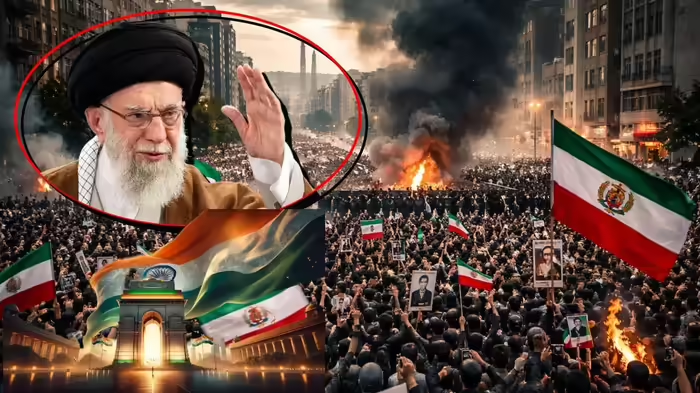
Unrest in Iran poses a serious concern for India’s economic, strategic, and diplomatic interests. Key regional engagements, such as the Chabahar port project and access to Central Asia, could be jeopardized. A sudden change in leadership may produce unpredictable outcomes, directly affecting India’s regional position.
Iran: More Than Just a Regional Story
While global attention focuses on protests and instability, for India, Iran’s turmoil is far from a distant problem. According to The Times of India, the real issue is not merely whether Iran’s leadership can withstand domestic unrest, but whether the country can continue to function as a stable and reliable state. Losing Iran as a trusted partner would be a major setback for New Delhi, especially in an already volatile neighborhood.
A Strategic Gateway to Central Asia and the Middle East
India’s relationship with Iran has historically been pragmatic rather than ideological. Tehran serves as the only viable overland route to Afghanistan and Central Asia, bypassing Pakistan. This strategic calculus gave birth to the Chabahar port project, India’s alternative connectivity corridor designed to overcome geographic and geopolitical constraints.
Professor Rajan Kumar of Jawaharlal Nehru University told TOI, “Iran has become India’s most important land bridge to Central Asia. Chabahar is more than a port—it represents India’s ability to achieve results despite structural constraints.” While sanctions, delayed funding, and political instability in Afghanistan have slowed progress, the strategic rationale behind Chabahar remains intact.
Escalating Risks
Long-term instability or a contested succession in Iran could directly threaten major infrastructure projects. Professor Kumar warns, “Post-Khamenei, Chabahar risks becoming a hostage to instability rather than a strategic asset.” Such a scenario could cut India’s only practical continental route to Central Asia.
Beyond Annual Trade Numbers
Critics often highlight the modest size of India-Iran trade—$1.3 to $1.7 billion annually—but focusing only on trade volume misses the bigger picture. India remains one of Iran’s top ten export partners, and has invested over $1 billion in Iranian infrastructure, particularly Chabahar. Disruptions could force India to incur financial losses or abandon long-term strategic plans.
Limiting Pakistan’s Regional Ambitions
Iran has quietly but effectively constrained Pakistan’s influence in the region. Despite shared religious ties, Tehran has never aligned with Islamabad’s stance toward India, including in Kashmir. During the 1990s, Iran opposed Pakistan-backed Taliban dominance in Afghanistan alongside India, limiting Islamabad’s ability to shape the region unilaterally. A weakened Iran could indirectly benefit Pakistan.
Uncertainty is the Real Threat
While some may assume that a leadership change would automatically bring a more liberal or externally oriented government, Indian strategists remain cautious. Dr. Ashok Sharma explains, “A change in leadership does not guarantee a fundamentally different or more open policy. Whether the government is Shia or Sunni, internal dynamics in West Asia are complex. From India’s perspective, unpredictability poses the greatest risk.”
New Delhi has learned to manage relations with Iran’s current leadership, even amid sanctions and restrictions. A successor government—especially one emerging from chaos—could be ideologically harder, more hostile, or externally dependent, threatening India’s hard-earned strategic leverage in the region.
Discover more from SD NEWS agency
Subscribe to get the latest posts sent to your email.