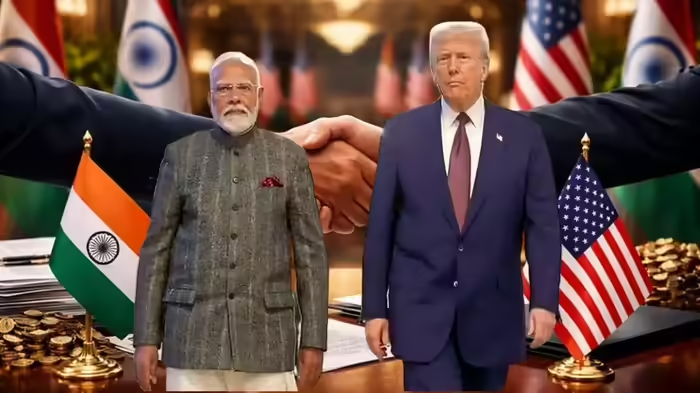
New Delhi: After months of anticipation, India has finally received a major boost on the global trade front. The long-awaited India-US trade deal has been officially announced by US President Donald Trump, triggering a positive reaction in Indian financial markets. Many experts believe this agreement could even surpass the recently signed India-European Union “mega deal” in terms of impact and strategic importance.
Under the agreement, reciprocal tariffs have reportedly been reduced to 18%, offering India immediate relief from uncertainty and trade pressure that had been building for months.
However, economists caution that while the deal is a strong step forward, it is not a magic solution for every economic issue India faces.
What Problems the Deal Will Solve
The India-US trade deal is expected to deliver immediate benefits in several key areas.
1. Reduced Trade Uncertainty
For months, India was grouped among countries facing steep US tariffs. The new agreement removes that fear and provides a more stable export environment. This is crucial for Indian exporters who were struggling to plan long-term orders and investments.
2. Improved Export Competitiveness
The reduction of tariffs brings India closer to competing nations such as Vietnam and Thailand, easing pressure on India’s export sector. Market experts believe this will improve business sentiment and strengthen demand for Indian goods in the US.
3. Support for the Rupee
The deal is expected to reduce pressure on the Indian currency by improving export inflows. The rupee has already responded positively—strengthening by more than 1% recently, signalling that aggressive betting against the currency may no longer be a one-way trade.
4. Control Over Current Account Deficit
Higher exports to the US could help India manage its Current Account Deficit (CAD), an important macroeconomic indicator that often determines currency stability and investor confidence.
Effective Tariff Could Drop to 12%-13%
Analysts estimate that India’s effective tariff burden may actually fall to around 12%-13%, down sharply from the earlier estimate of 30%-35%.
Rahul Bajoria, economist at BofA Securities, said that despite tariffs continuing on certain categories such as steel, aluminium, and automobiles under Section 232, the overall effective tariff rate will still remain far lower than earlier projections.
This could bring strong relief to labour-intensive sectors such as:
- Gems and jewellery
- Textiles
- Agriculture products
- Engineering goods
In addition, sectors like pharmaceuticals and consumer electronics have reportedly been exempted from the earlier proposed 50% tariff, further easing trade pressure.
But Tariffs Still Higher Than Earlier Levels
Despite the relief, experts highlight that the tariffs remain significantly higher than the pre-Trump tariff era. For instance, in 2024, the weighted average US tariff on Indian goods was only around 2.5%.
This means that while the reduction from 50% to 18% is substantial, Indian exporters are still operating in a tougher trade environment compared to the past.
India Gains an Edge Over ASEAN Competitors
The deal is being viewed as strategically important because it could provide India a slight advantage over its ASEAN rivals.
According to Wendy Cutler, Senior Vice President at the Asia Society Policy Institute and former acting US Trade Representative, India’s reduced tariff level could give Indian exporters an edge compared to competitors who negotiated tariff rates closer to 19%-20%.
What Challenges Will Still Remain
While the agreement solves immediate uncertainty, several medium-term and structural issues remain unresolved.
1. Capital Outflows and Weak FDI
India continues to face challenges such as foreign capital leaving markets and slower foreign direct investment (FDI) inflows. These issues cannot be fixed overnight, even with a favourable trade agreement.
2. Higher Energy Import Cost Risk
A complete ban on Russian oil imports could slightly raise India’s overall energy import costs. Since oil remains India’s biggest import, any rise in crude prices directly affects inflation and the trade deficit.
3. Long-Term Trade Commitments Still Unclear
India has reportedly agreed to purchase $500 billion worth of US products, but no clear timeline has been provided. Experts believe that the real impact of this commitment will depend on how and when India executes these purchases.
India-US Trade Figures
Trade numbers underline the growing importance of the US as India’s largest strategic trade partner.
- In FY 2024-25, India’s imports from the US stood at $46 billion
- During the same period, India’s exports to the US were $86.5 billion
- In the current financial year (April–December), exports to the US grew 9.75%, reaching $65.87 billion
Meanwhile, India’s petroleum imports from Russia have declined sharply.
- In FY 2024-25, Russia oil imports were $53.5 billion
- In FY 2025-26 so far, it has dropped to $33 billion
Conclusion
The India-US trade deal is undoubtedly a major achievement that brings India immediate relief by lowering tariff pressure, boosting exports, strengthening the rupee, and improving market confidence.
However, experts agree that it is not a one-stop solution for all of India’s economic challenges. Issues like FDI slowdown, capital outflows, and energy security concerns will still require long-term policy reforms and strategic planning.
In short, the deal is a powerful step forward—but the road to complete economic stability still has several hurdles ahead.
Discover more from SD NEWS agency
Subscribe to get the latest posts sent to your email.