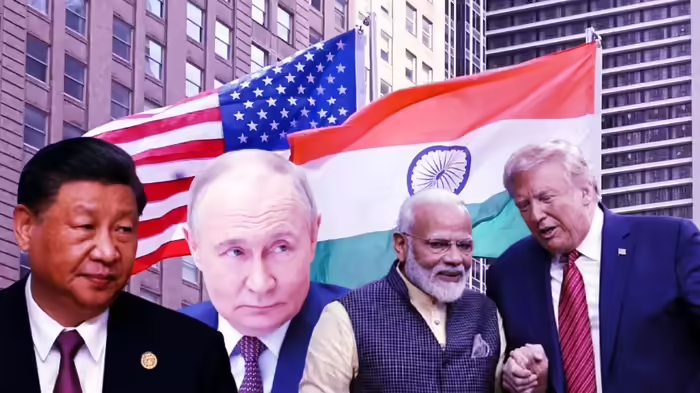
New Delhi: India and the United States are deepening their economic and strategic relationship, reshaping key geopolitical dynamics. Following the announcement of a bilateral trade deal, India has joined the U.S.-led strategic alliance Pax Silica, signaling closer cooperation in critical minerals and supply chains. This growing India-U.S. partnership is likely to be viewed differently by Russia and China.
Commerce and Industry Minister Piyush Goyal announced that an interim trade agreement between India and the U.S. is expected to be signed in March and implemented by April. Earlier this month, both countries released a framework for the first phase of the bilateral trade deal, and final negotiations will be held in Washington from February 23 for three days.
The accelerated pace of the trade agreement coincides with India’s inclusion in Pax Silica, aimed at building supply chains for critical minerals, particularly in the semiconductor and AI sectors, reducing China’s dominance. While Russia, India’s longstanding ally, trusts New Delhi to maintain strategic autonomy, China perceives the development as a potential counterbalance to its influence.
Key Details of the Trade Agreement
- The interim deal will include reciprocal tariff reductions on several goods. The U.S. has agreed to lower tariffs on Indian products from 25% to 18%, including lifting the 25% additional tariff imposed on Indian imports of Russian crude oil. Previously, domestic exporters faced tariffs of up to 50%.
- Goyal emphasized that the deal opens “significant commercial opportunities” for Indian exporters, particularly in labor-intensive sectors like textiles, leather, and marine products, which suffered under higher tariffs. Sensitive sectors, including agriculture, will remain protected.
- The agreement also ensures that sectors such as gems and jewelry, and spices, will benefit from the tariff reductions.
Strategic Implications
Joining Pax Silica goes beyond trade, representing deeper collaboration in critical supply chains. The alliance aims to reduce dependence on China for semiconductors and AI-related minerals. India’s participation is expected to be a strategic challenge for China while maintaining its independent foreign policy stance.
Goyal highlighted the strategic rationale behind the U.S. imports, stating, “India needs advanced technology and essential raw materials. As our steel production is set to double from 140 million to 300 million tons over the next five to six years, significant investments in the sector, approximately ₹10 lakh crore, are underway, requiring coking coal imports.”
Geopolitical Reactions
- Russia: Views India’s move as an attempt to balance ties between Western and Eastern blocs, maintaining trust in New Delhi’s strategic autonomy.
- China: Likely to interpret India-U.S. closeness as a countermeasure to Chinese influence, both at the border and economically, perceiving potential threats to its security and regional dominance.
The trade deal has also sparked domestic political debate. Congress leader Rahul Gandhi questioned why India agreed to increase imports from the U.S. without reciprocal commitments. Goyal responded by highlighting the benefits for Indian exporters and workers affected by previous high tariffs, emphasizing the practical advantages for the country’s industries.
Discover more from SD NEWS agency
Subscribe to get the latest posts sent to your email.