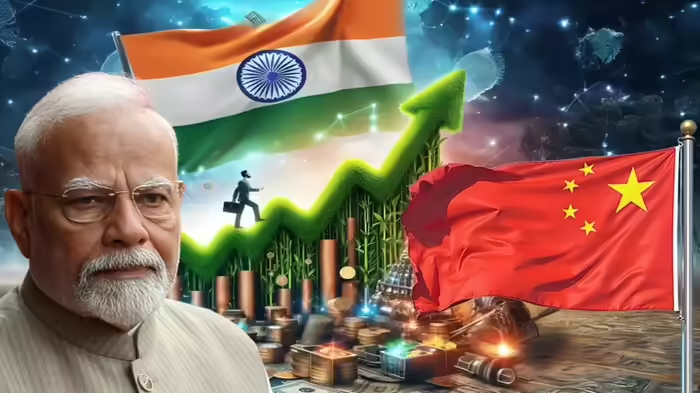
New Delhi: India is on track to achieve another significant milestone in its economic journey. According to a report by SBI Research, the country is expected to enter the upper-middle-income group by 2030, joining nations like China and Indonesia. By this timeline, India’s per capita income is projected to reach $4,000, reflecting a major shift in the nation’s income profile.
The report further highlights that India is likely to become the world’s third-largest economy by 2028, a feat underpinned by strong economic policies and robust growth potential.
Global Income Classification
The World Bank classifies countries into four income groups based on per capita Gross National Income (GNI):
- Low income
- Lower-middle income
- Upper-middle income
- High income
In 1990, out of 218 countries, 51 were in the low-income category, which reduced to 26 by 2024. High-income countries grew from 39 in 1990 to 87 in 2024.
India’s Progress Since Independence
Post-independence, India took 60 years to move out of the lower-middle-income category. In 1962, per capita GNI stood at just $90. By 2007, it rose to $910. Subsequently, India accelerated its growth:
- 2009: $1,000 per capita income
- 2019: $2,000
- 2026 (estimate): $3,000
SBI Research forecasts that by 2030, per capita income will reach $4,000, officially placing India in the upper-middle-income bracket alongside China and Indonesia.
Path to High-Income Status
To become a high-income country, India needs to grow per capita GNI at an annual compounded rate of 7.5% up to 2047. Historically, from 2001–2024, this rate averaged 8.3%, suggesting the target is achievable. If the high-income threshold rises from $13,936 to $18,000 by 2047, India would need to maintain 8.9% annual growth in per capita income.
Economic Outlook and Global Standing
India’s economic trajectory is equally impressive on the global scale. SBI Research projects India’s economy to reach $5 trillion by 2028 and potentially $10 trillion by 2035. Currently, the U.S. leads the world in GDP, followed by China. By 2028, India is expected to surpass Germany to become the third-largest economy.
From being the 14th largest economy in 1990, India is set to become the fourth largest by 2025, reflecting rapid economic advancement over the past few decades.
Key Focus Areas for Sustained Growth
The SBI report emphasizes the importance of continuing economic reforms to maintain momentum and achieve accelerated growth. It suggests that with the right policy measures, India could sustain GDP growth of 11–11.5% at current prices, enabling it to reach upper-middle-income status by 2030 and high-income status by 2047.
This projection underscores India’s strong economic policies, structural reforms, and capacity for sustained development.
Discover more from SD NEWS agency
Subscribe to get the latest posts sent to your email.