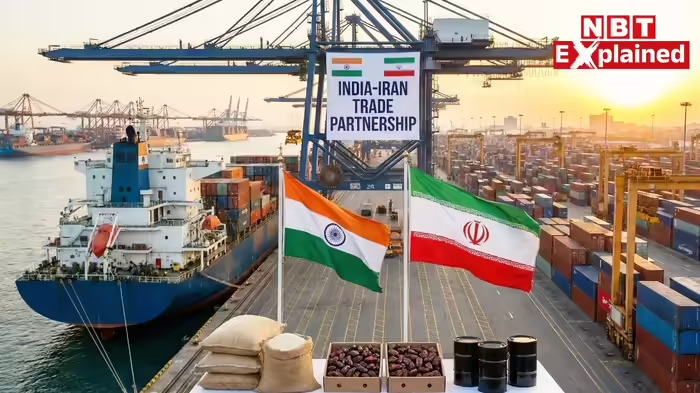
The United States has announced a sweeping 25% tariff on countries that continue trade relations with Iran, a move that could pose fresh economic and diplomatic challenges for India. As one of Iran’s key trading partners, India now finds itself navigating a complex situation that could affect everything from saffron imports to strategic infrastructure projects.
US President Donald Trump described the decision as a “final and decisive measure” aimed at increasing pressure on Tehran amid growing internal unrest. However, the move directly targets Iran’s major trade partners and risks further straining New Delhi–Washington relations.
Could India Face an Effective 75% US Tariff?
The Iran-related tariff adds to existing trade pressures on India. The US has already imposed a 25% reciprocal tariff on Indian goods, along with an additional 25% duty in response to India’s continued purchase of Russian crude oil. If the new Iran-linked tariff is enforced, Indian exports to the US could effectively face tariffs of up to 75%, severely undermining competitiveness across multiple sectors.
India Among Iran’s Top Five Trade Partners
Despite China being Iran’s largest trading partner, India has consistently remained among Tehran’s top five. According to the Indian Embassy in Tehran, bilateral trade in FY 2024–25 stood at approximately $1.68 billion. Of this, India’s exports accounted for $1.24 billion, while imports from Iran were valued at around $440 million.
What India Exports to Iran
India exports a wide range of goods to Iran, including organic chemicals, basmati rice, tea, sugar, pharmaceuticals, fruits, pulses, meat products, spices, and seasonal produce such as bananas. In addition, agricultural and industrial machinery, iron and steel, fertilizers, textiles, rubber products, and pharmaceutical inputs form a significant part of India’s export basket.
What India Imports from Iran
India imports several critical commodities from Iran, notably methanol, petroleum bitumen, liquefied propane, apples, dates, chemicals, and industrial-use acyclic alcohols. The country also sources petroleum coke, almonds, pistachios, and saffron from Iran — commodities that are widely used in Indian households and industries. Crude oil imports from Iran have fluctuated sharply in recent years due to US sanctions.
Trade Marked by Volatility
India–Iran trade has seen sharp ups and downs due to sanctions and geopolitical tensions. After a steep decline in 2020–21, bilateral trade rebounded to $2.33 billion in 2022–23, only to fall again in 2023 following renewed restrictions.
In October 2025, India exported goods worth $56.1 million to Iran while importing $28.3 million, resulting in a trade surplus of $27.9 million. However, exports declined by 29% year-on-year, largely due to reduced shipments of basmati rice, glassware, and engineering goods.
Sectors Likely to Be Hit
If US tariffs are strictly enforced, Indian companies may be compelled to scale back transactions with Iran to preserve access to the American market. This could significantly impact exporters in the chemical, agricultural, and pharmaceutical sectors, which rely heavily on Iranian demand.
Strategic Stakes: Chabahar Port
Beyond trade, India’s strategic interests are deeply tied to Iran through the Chabahar Port project. The US had extended a sanctions waiver for the port for six months last year, valid until April 2026, after briefly withdrawing it in September 2025. The waiver, originally granted in 2018, allowed India to develop Chabahar as a gateway to Afghanistan and Central Asia, bypassing Pakistan.
If the exemption lapses, entities involved in Chabahar’s operations could face US sanctions under Iran-related non-proliferation laws. The port holds critical strategic value for India, particularly as it seeks to strengthen ties with Afghanistan amid gradually improving engagement with the Taliban-led administration in Kabul.
A Delicate Balancing Act
As geopolitical tensions intensify, India faces a delicate balancing act — safeguarding its economic interests, maintaining strategic autonomy, and managing relations with both Washington and Tehran. The outcome will shape not only trade flows but also India’s broader regional and global positioning.
Discover more from SD NEWS agency
Subscribe to get the latest posts sent to your email.