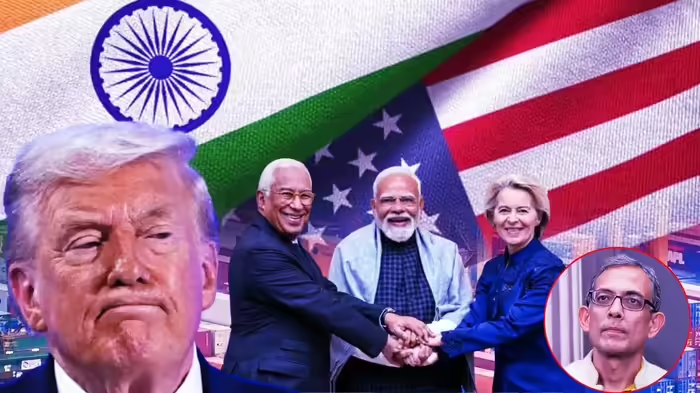
New Delhi: Nobel laureate economist Abhijit Banerjee has described the India-European Union (EU) Free Trade Agreement (FTA) as a “strategic alignment” that sends a clear message to the United States: “India does not need the U.S. as much as the U.S. thinks it does.” Banerjee made these remarks amid high U.S. tariffs imposed under President Donald Trump’s administration.
While the deal is expected to bring significant benefits for India, Banerjee cautioned that these advantages will not materialize automatically. He emphasized the urgent need for India to improve logistics, delivery speed, and overall efficiency to fully capitalize on the FTA, which has been dubbed the “mother of all deals.”
Strategic Significance
Speaking in an exclusive conversation, Banerjee noted that India has yet to fully understand the nature of U.S. resistance under Trump. Although the U.S. repeatedly proposed trade discussions, its interest in substantive negotiation with India has remained limited.
Banerjee said, “This is certainly a strategic alignment. The FTA between India and Europe signals to the U.S. that we are not as dependent on them as they assume. This could be useful if we want to bring the U.S. to the negotiating table.” However, he expressed doubts about how much actual bargaining leverage the deal would provide.
Trade Deals Are Just the Beginning
Banerjee described trade agreements as initial steps, creating access to a market of nearly two billion people. He stressed, “It’s not enough to have a trade deal. You need products to sell, and the market must want those products. Today’s competition goes far beyond tariffs.”
Officials say the FTA will cover roughly one-fourth of the global GDP, reduce tariffs on 99% of Indian exports to the EU, and lower duties on over 97% of EU goods imported into India. Key sectors in India expected to benefit include textiles, apparel, leather, handicrafts, footwear, and seafood, while Europe stands to gain in beverages, automobiles, chemicals, and pharmaceuticals.
Efficiency: The Real Bottleneck
Banerjee highlighted that India’s advantage in sectors such as jewelry and leather is clear, but results may vary in textiles, depending on product type. Competing countries like Vietnam and Bangladesh have already captured significant market share.
He argued that the real challenge is delivery speed and supply chain efficiency. Speaking at a discussion in Kolkata on his book Poor Economics, Banerjee said, “Retailers in the U.S. tell me Indian suppliers are slow. Our transport infrastructure is inefficient, ports are slow – these factors matter.”
Lessons from China
Comparing India with China, Banerjee noted that Chinese suppliers achieve exceptionally fast turnaround, often outweighing price advantages elsewhere. “If a country offers the same price but faster delivery, buyers will go there,” he said. India must reach Chinese-level efficiency to fully benefit from trade deals. “We need to master efficiency. If we reach China’s level, I am confident we can turn these deals into real gains. But it will not happen automatically.”
Tariff Challenges and Global Context
High U.S. tariffs have disrupted global trade flows, with India facing duties of up to 50%, including a 25% tariff on Russian oil. India has criticized these actions as unfair and illogical, asserting that its energy policy is guided by national interest. The EU, too, is confronting the threat of U.S. tariffs. Many analysts view the FTA as gaining urgency due to the frosty relations between India, Europe, and the Trump administration.
In the financial year 2024-25, India-EU trade totaled approximately $136 billion, with exports at $76 billion and imports at $60 billion.
Discover more from SD NEWS agency
Subscribe to get the latest posts sent to your email.