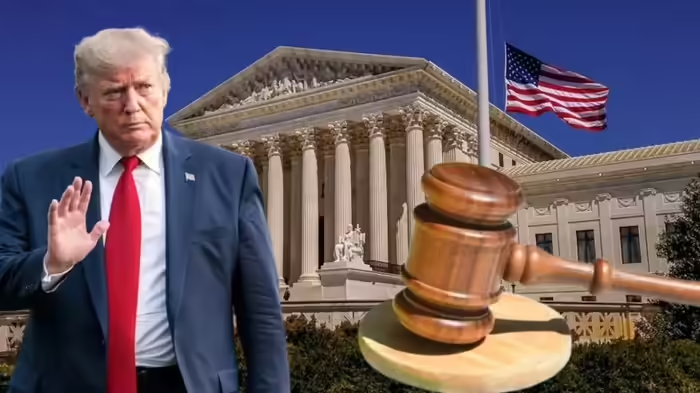
New Delhi: The US Supreme Court recently struck down President Donald Trump’s global tariff orders, citing the International Emergency Economic Powers Act (IEEPA) as misused. Trump had relied on IEEPA to implement tariffs, but the court ruled that the authority to impose tariffs lies with Congress, not the President. The ruling affects tariffs imposed after February 2025.
What is IEEPA?
The International Emergency Economic Powers Act (IEEPA), enacted in 1977, grants the US President authority to regulate economic transactions during national emergencies involving foreign threats. The law empowers the President to:
- Control imports and exports
- Freeze or block foreign assets
- Regulate financial transactions and banking
- Limit foreign investments
- Enforce economic decisions immediately
However, the law does not specifically authorize tariffs, which are explicitly under Congress’s constitutional powers.
Trump’s Use of IEEPA
While previous US presidents used IEEPA to impose sanctions or trade restrictions, Trump was the first to attempt global tariffs under this law. During his tenure, he declared 22 national emergencies, using IEEPA in most cases. Since its enactment, IEEPA has been invoked 82 times, covering nearly 90% of all declared US national emergencies. The first use was by President Jimmy Carter in 1979 to block Iranian assets during the hostage crisis.
Supreme Court Ruling
In a 6-3 decision, Chief Justice John Roberts clarified that IEEPA allows the President to regulate imports during emergencies, but does not grant authority to impose broad tariffs. Roberts emphasized that tariff powers belong to Congress, and Trump’s administration failed to cite any law within IEEPA that authorized such tariffs.
Key Takeaway
The ruling underscores the constitutional limit on executive power: while the President can use IEEPA to block assets, restrict trade, and control financial transactions, imposing tariffs requires legislative authorization. Trump’s attempt at using IEEPA for global tariffs has set a clear precedent on the separation of powers in US trade policy.
Discover more from SD NEWS agency
Subscribe to get the latest posts sent to your email.