
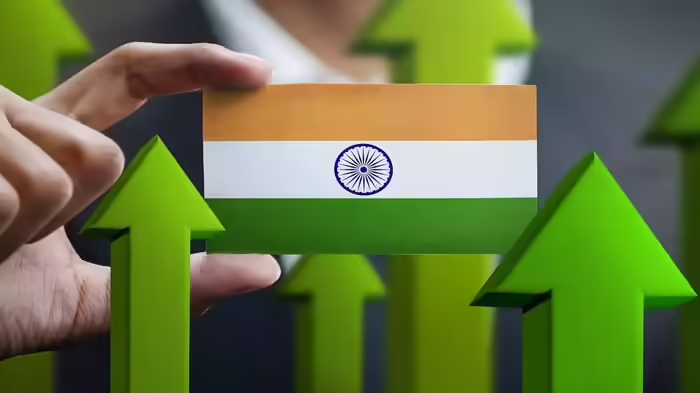
New Delhi: Once labeled as India’s underperforming “BIMARU” states, Bihar, Uttar Pradesh, Rajasthan, and Assam are now emerging as engines of the nation’s economic growth. A recent HSBC report highlights that post-pandemic, low-income states are catching up rapidly with wealthier states, marking a new phase of economic convergence.
Emerging States Lead Economic Recovery
According to the report, the growth pattern of these states differs significantly from the pre-COVID era (FY13–FY19), when richer states expanded faster. This new “growth convergence” is driven by increased income and strategic public capital expenditure (CapEx) rather than population factors.
States like Bihar, UP, Rajasthan, and Assam have boosted infrastructure development through higher CapEx, signaling stable governance and attracting private investment. Enhanced revenues in these emerging states have fueled further investment cycles. Post-pandemic fiscal transfers from the central government have also strengthened state finances, enabling sustained development spending.
Bihar Tops the Chart
Between FY23 and FY25, Bihar recorded a real GSDP growth of 10.3%, while UP grew at 9.0%, both surpassing the national average of 7.8%. Bihar achieved a significant milestone in FY25, with industry’s share in GVA rising from 22.4% in agriculture to 23.2%, signaling diversification. Meanwhile, UP saw remarkable growth in exports of electronics, IT products, and high-tech services from FY17 to FY25.
HSBC attributes this post-pandemic acceleration to the Solow-Swan growth model, which predicts that regions with lower capital-to-labor ratios grow faster. Pranjul Bhandari, Chief India Economist at HSBC, said, “Wealthy states are near their growth ceiling, so expansion slows. Poorer states are far from their frontier; hence, adding capital generates significant growth, accelerating development.”
Risks to Sustaining Growth
Despite strong CapEx-led expansion, there are challenges ahead:
- Central tax revenue growth is slowing due to lower tax rates and weak nominal GDP growth, potentially reducing the share of funds allocated to states (41% of central divisible pool).
- Populist cash transfer schemes are increasing current expenditures and fiscal deficits.
The report notes that even though states maintained CapEx in FY25 despite declining revenues, deficits have grown substantially. Any further decline in revenues or increased expenditure on populist schemes could hit infrastructure spending first, threatening the momentum of this emerging growth cycle.
Bottom Line: The so-called BIMARU states are no longer laggards—they are driving India’s post-pandemic economic resurgence, narrowing the gap with richer states, but sustaining this trajectory will require careful fiscal management.
Discover more from SD NEWS agency
Subscribe to get the latest posts sent to your email.