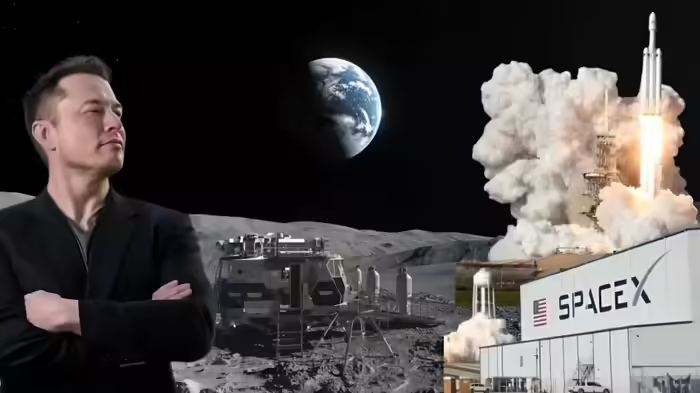
New Delhi: SpaceX founder Elon Musk has unveiled an ambitious plan to establish a human settlement on the Moon within the next decade. For now, the company has put its Mars colonization plans on hold, focusing entirely on making the Moon humanity’s first off-Earth city.
This marks a strategic shift for SpaceX, which has become a key contractor for NASA. Musk’s lunar vision aligns with U.S. President Donald Trump’s renewed focus on sending humans to the Moon. Posting on social media, Musk stated:
“SpaceX is now concentrating on building a self-sustaining city on the Moon. We can achieve this in under 10 years, whereas establishing a similar settlement on Mars would take over 20 years.”
Why Mars Plans Are Delayed
Musk cited logistical challenges as the reason for postponing Mars missions. He explained that travel to Mars depends on planetary alignment, which occurs only once every 26 months, whereas lunar launches could happen every 10 days.
Despite this shift, Musk emphasized that Mars remains part of SpaceX’s long-term vision, with preliminary work expected to start in 5 to 7 years.
Changing Timelines and Focus on the Moon
SpaceX’s Mars mission timelines have been repeatedly adjusted over the years. In 2016, Musk projected that, with sufficient funding and technology, human missions to Mars could occur by 2024. Earlier, he had told the Wall Street Journal that, under ideal conditions, humans could reach Mars in 10 years, and under challenging conditions, in 15–20 years.
The renewed lunar focus also reflects policy changes under the Trump administration, which issued an executive order aiming for an American presence on the Moon by 2028. SpaceX, as a key contractor for NASA’s Artemis program, is central to achieving this goal. NASA currently plans to send astronauts back to the lunar surface with Artemis 3 by mid-2027, though experts caution delays are possible due to the Moon lander still being under development.
Cost of Reaching the Moon
Sending humans to the Moon remains extremely expensive. Reports estimate that government space agencies may spend over $100 billion just to reach lunar orbit. For private companies, passenger costs could range from $100 million to $750 million per seat.
For perspective, Neil Armstrong’s Apollo 11 mission in 1969, which first landed humans on the Moon, cost roughly $350 million at the time — equivalent to $250 billion today. NASA’s Artemis program is projected to cost around $95 billion to reach the Moon.
Musk asserts that easier and more frequent lunar access makes building a city on the Moon far more feasible than on Mars, potentially accelerating humanity’s first permanent off-world settlement.