New Delhi:
At a time when Pakistan is battling one of the worst economic crises in its history, the country’s decision to commit $1 billion to former US President Donald Trump’s proposed international initiative, the “Board of Peace,” has sparked sharp debate and raised serious questions about its financial priorities.
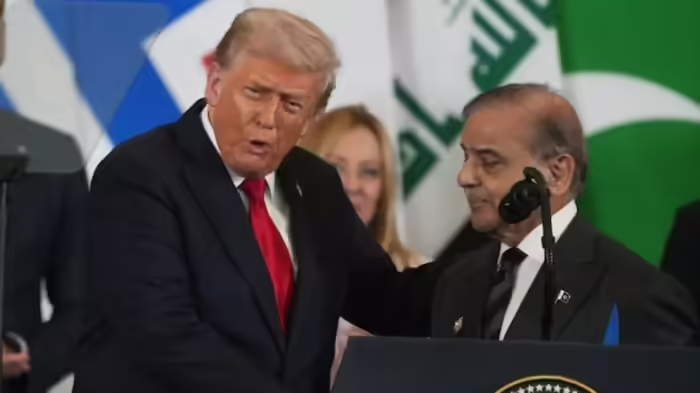
The Board of Peace, announced by Trump, is envisioned as a global platform involving leaders from 60 countries, aimed at restoring peace and rebuilding war-ravaged Gaza. Countries contributing $1 billion are promised permanent seats on the board. Pakistan has confirmed its willingness to join, placing it alongside India and several Islamic nations.
Economic Distress vs Diplomatic Ambition
Pakistan’s move comes amid deep financial distress. The country remains heavily dependent on international lenders, including the International Monetary Fund (IMF) and the World Bank, to prevent economic collapse. In December 2025, the IMF approved a $1.2 billion bailout tranche, providing temporary relief to Islamabad.
Despite this, Pakistan continues to seek further assistance under a proposed $7 billion IMF loan programme, underscoring the fragility of its economy.
Appeals for Help from Gulf Nations
Beyond multilateral lenders, Pakistan has also turned to the United Arab Emirates, requesting an extension on the repayment of a $2.5 billion loan deposited with the State Bank of Pakistan in 2021. The loan was originally scheduled to be repaid in two instalments.
Analysts believe Pakistan’s outreach to Gulf countries is aimed at keeping IMF negotiations on track, as external financial support remains critical for meeting bailout conditions.
Mounting Debt Burden
As of June 2025, Pakistan’s total debt stood at $286.83 billion, marking an increase of nearly 13 percent year-on-year. The country is also weighed down by substantial domestic borrowing, further straining public finances.
Meanwhile, the World Bank approved $700 million in fresh financial assistance last month, part of a broader programme designed to stabilise Pakistan’s economy and improve governance and public services.
Foreign Exchange Reserves Under Pressure
Pakistan’s foreign exchange reserves remain precarious. The State Bank of Pakistan reported a modest increase of $118 million last week, taking total reserves to approximately $10.33 billion—barely sufficient to cover a few weeks of imports.
In contrast, India’s foreign exchange reserves rose by $392 million, reaching $687.19 billion, highlighting the stark economic disparity between the two neighbours.
Political Justification
Defending the decision, Pakistan’s Foreign Minister Ishaq Dar said the move aligns with Pakistan’s support for peace efforts in Gaza. According to The Tribune, Dar expressed hope that the Board of Peace would help secure a permanent ceasefire and facilitate meaningful reconstruction.
A Question of Priorities
Critics argue that Pakistan’s willingness to spend $1 billion on diplomatic prestige while relying on international loans for survival reflects a disconnect between its foreign policy ambitions and economic realities.
Whether this decision is driven by strategic necessity or political symbolism remains unclear—but for a country struggling to stabilise its economy, the timing could hardly be more controversial.
Discover more from SD NEWS agency
Subscribe to get the latest posts sent to your email.