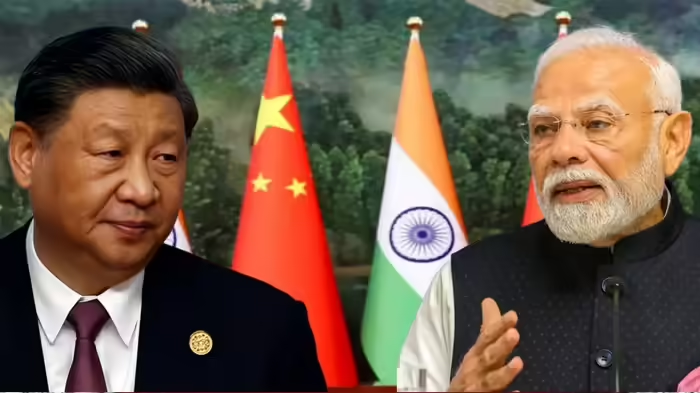
New Delhi: India is moving swiftly to strengthen its supply of critical minerals amid growing concerns over its heavy dependence on China. Recognizing the strategic importance of minerals like lithium and rare earth elements, the Indian government is actively engaging with Brazil, Canada, France, and the Netherlands to build a stronger and more reliable global supply network.
According to official sources, discussions are underway for joint exploration, extraction, processing, and recycling agreements, aimed at ensuring uninterrupted access to these key resources. These minerals are essential for the production of electric vehicles, renewable energy systems, advanced electronics, and modern industrial infrastructure.
China Dominates Global Rare Earth Supply
China currently holds overwhelming control over the global rare earth sector — from mining to processing and supply. This dominance has raised alarms across major economies, including India, as rare earth materials are increasingly seen as a tool of geopolitical influence.
India believes that over-reliance on China could pose serious risks to its energy transition goals and industrial development.
India Expands Global Partnerships
India has already taken steps in this direction. In January, India signed a major agreement with Germany, focusing on cooperation in critical minerals across India, Germany, and third countries. The deal includes provisions for exploration, mineral processing technology access, recycling, and acquisition of mineral assets.
Additionally, India has earlier signed agreements with Argentina, Australia, and Japan, and is currently negotiating wider bilateral pacts with Peru and Chile, where critical minerals remain a key component of discussions.
Canada Deal in Focus, PM’s India Visit Expected
Canada is emerging as a major partner in India’s critical mineral strategy. Reports suggest that Canadian Prime Minister Mark Carney may visit India in early March. During the visit, agreements related to uranium energy, critical minerals, and artificial intelligence are expected to be signed.
Canada’s Natural Resources Department has also indicated that both nations have agreed to formalize cooperation on critical minerals in the coming weeks.
Global Concern Over China’s Reliability
India’s move aligns with global efforts to reduce dependence on China. Recently, finance ministers from G7 nations and other major economies met in Washington to explore strategies to reduce reliance on Chinese rare earth supply chains, fearing that China could use these minerals as an economic and strategic weapon.
Critical Minerals Declared Strategic Priority
In 2023, India identified more than 20 minerals, including lithium, as “critical” to meet the rising demand of energy transition, infrastructure expansion, and industrial development.
Experts believe that if India succeeds in securing alternative supply routes and developing domestic processing capabilities, it could significantly reshape the global critical mineral supply chain — potentially turning the tables in its favor.
India’s growing international outreach reflects a clear strategy: reduce dependency on China and ensure long-term mineral security to power its clean energy ambitions and industrial growth.
Discover more from SD NEWS agency
Subscribe to get the latest posts sent to your email.