New Delhi:
Tata Motors has firmly consolidated its leadership in India’s electric vehicle market, with Tata.ev surpassing the landmark sale of 250,000 electric passenger vehicles. The achievement underscores the rapid adoption of electric mobility in India and positions Tata Motors as the undisputed leader in the country’s EV segment.
Since the launch of the Nexon.ev in 2020, Tata.ev has consistently dominated the electric passenger vehicle market. Today, the company sells one out of every two electric cars in India, with strong demand across models such as Tiago.ev, Punch.ev, Nexon.ev, Curvv.ev, and Harrier.ev. Tata’s EV footprint now extends to over 1,000 cities and towns, reflecting deep penetration beyond major urban centres.
Nexon.ev Sets Benchmark
The Tata Nexon.ev has emerged as a flagship success, becoming India’s first electric car to cross 100,000 unit sales. This milestone highlights growing consumer confidence in electric vehicles and Tata Motors’ ability to deliver reliable and accessible EV solutions across the country.
Usage Trends Highlight EV Acceptance
Customer data reveals strong real-world adoption. Nearly 84% of Tata.ev owners use their EV as their primary vehicle, while over 26% are first-time car buyers. On average, Tata EV owners drive around 20,000 kilometres annually, with nearly 26,000 customers having crossed the 100,000-kilometre mark—a testament to the durability and practicality of electric vehicles.
Long-distance travel is also gaining traction, with around 50% of Tata.ev customers having completed journeys exceeding 500 kilometres. Collectively, Tata EVs have covered approximately 12 billion kilometres, significantly contributing to environmental sustainability.
Environmental Impact
This extensive usage has resulted in a reduction of around 1.7 million tonnes of carbon dioxide (CO₂) emissions and savings of nearly 800 million litres of fossil fuel, reinforcing the role of electric mobility in India’s clean energy transition.
Major Product Offensive Planned for 2026 and Beyond
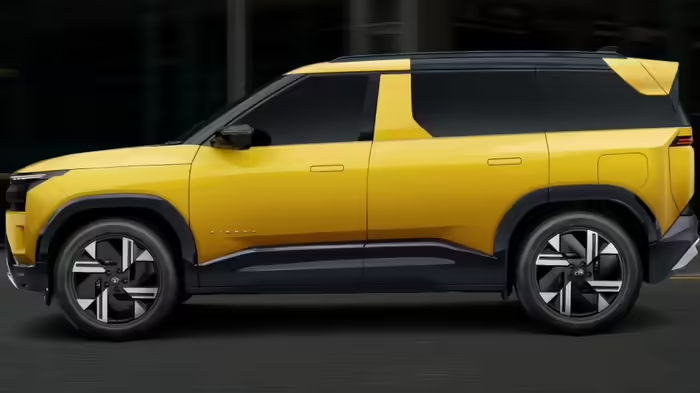
Looking ahead, 2026 is set to be a pivotal year for Tata.ev. The company plans to launch the much-anticipated Sierra.ev, along with a facelifted Punch.ev and the futuristic Avinya EV. By 2030, Tata Motors aims to introduce five all-new EV models, including Sierra and Avinya, alongside several upgraded offerings, as part of its long-term strategy to retain market leadership.
Expanding Charging Infrastructure
Tata.ev is also aggressively strengthening India’s charging ecosystem. The company currently supports over 200,000 charging points and plans to scale this network to one million charging units by 2030. This includes home chargers, residential society installations, and public charging stations. Tata’s charging aggregator connects over 20,000 public charging points and operates the country’s largest network of superfast chargers. On major highways, 100 Mega Charging Hubs are already operational, offering up to 120kW+ fast-charging speeds with multiple charging bays.
Leadership Speaks
Commenting on the milestone, Shailesh Chandra, Managing Director and CEO of Tata Motors Passenger Vehicles Ltd., said that crossing 250,000 EV sales reflects how rapidly electric mobility is becoming an integral part of Indian life. He noted that Tata’s EV journey, which began in 2018, was not merely about market leadership but about building a comprehensive ecosystem to enable India’s shift towards clean mobility, supported by progressive government policies and strong partnerships.
Discover more from SD NEWS agency
Subscribe to get the latest posts sent to your email.