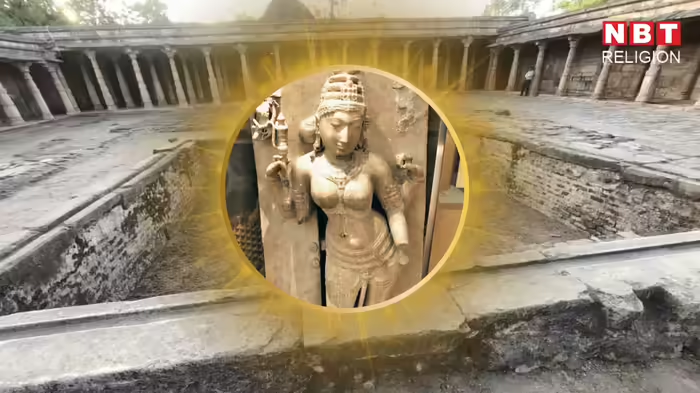
Ahead of Basant Panchami, one of Hinduism’s most revered festivals dedicated to Goddess Saraswati, the Supreme Court of India has directed shared use of the historic Bhojshala complex in Dhar, an archaeological site at the centre of a long-standing dispute between Hindu and Muslim communities.
The court’s order comes as Basant Panchami coincides with Friday prayers, prompting concerns over access to the monument. In its ruling, the apex court permitted Hindu worship from sunrise to sunset, while allowing Muslim prayers between 1 pm and 3 pm, ensuring that both communities can observe their respective religious practices peacefully on the same day.
The Bhojshala complex, believed to be over 1,100 years old, dates back to the reign of Paramara king Raja Bhoj (1000–1055 CE). According to historical accounts, Raja Bhoj established the site as a prominent centre of learning, where subjects such as philosophy, language, music, and culture were studied. The Hindu side regards the structure as a temple dedicated to Vagdevi (Goddess Saraswati), while the Muslim community claims it as the Kamal Maula Mosque.
Petitions were filed seeking exclusive access to the site on Basant Panchami. However, the court opted for a status-quo arrangement, allowing shared use under a fixed schedule. The Archaeological Survey of India (ASI) has earlier permitted Hindu prayers on Tuesdays and on Basant Panchami, while Muslims have traditionally offered namaz on Fridays at the site.
Historical Significance of Bhojshala
Historians associate Bhojshala with an ancient centre of education established during Raja Bhoj’s rule. Hindu traditions hold that an idol of Goddess Saraswati, revered as Vagdevi, once stood here. Architectural remnants and inscriptions found at the site are often cited by scholars as evidence of its layered history.
Who is Vagdevi?
Ancient Hindu scriptures describe Goddess Saraswati as Vagdevi and Brahmaswarupa, symbolising knowledge, wisdom, and creativity. Texts such as the Vishnudharmottara Purana portray her as a four-armed deity adorned with ornaments, while the Skanda Purana describes her seated on a lotus, embodying intellect and artistic excellence.
Significance of Saraswati Puja
Basant Panchami marks the believed manifestation of Goddess Saraswati on the fifth day of the bright fortnight of Magha. The day holds special importance for students, scholars, artists, and musicians, who seek blessings for learning, wisdom, and creativity.
As celebrations begin across the country, the Supreme Court’s directive aims to maintain communal harmony while respecting the religious sentiments attached to one of central India’s most historically significant monuments.
Discover more from SD NEWS agency
Subscribe to get the latest posts sent to your email.