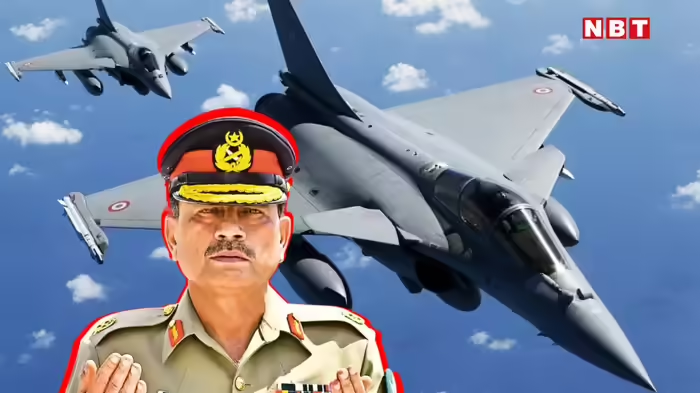
Islamabad: India may soon finalize a massive deal to purchase 114 Rafale fighter jets from France, a move that has triggered serious चिंता in Pakistan’s strategic circles. According to news agency ANI, the agreement—worth nearly ₹3.25 lakh crore—could be signed next month during French President Emmanuel Macron’s visit to New Delhi.
French media reports suggest that this mega‑deal would dramatically reshape the balance of air power in South Asia. Pakistani defense experts have described the potential induction of 114 advanced Rafales into the Indian Air Force (IAF) as a “major strategic shift” and a “deeply worrying signal” for Pakistan.
Prominent Pakistani defense analyst Bilal Khan said that the real threat is not just the sheer number of Rafales but the way India is building a deeply integrated, network‑centric air force around a common modern multirole platform. He argued that such a structure would give India major advantages in training, logistics, maintenance, and operational doctrine.
“This is not just about 114 new jets. It’s about how efficiently India can manage and integrate them into a broader combat ecosystem,” Khan said. “That is far more dangerous for Pakistan than numbers alone.”
Khan noted that the Rafale deal could finally resolve India’s long‑standing fighter squadron shortage and restore its numerical and technological edge in any future conflict. He warned that with nearly 200 Rafales in the long term, over 100 Tejas fighters, and modernized Su‑30MKI aircraft, the IAF would gain unmatched depth, endurance, and flexibility across air‑defense, strike, and counter‑air missions.
J‑35 Not a True Counter to Rafale
Rejecting speculation that Pakistan could neutralize India’s Rafales by purchasing China’s J‑35 stealth fighter, Khan said such a move would not be a direct जवाब to Rafale. Even if Pakistan acquires the J‑35, he argued, it should be seen as an attempt to fill a long‑standing capability gap in deep‑strike stealth operations—not as a true counter to India’s Rafale fleet.
“Rafale is not just a fighter jet. It is part of a much larger ecosystem of sensors, weapons, and data links,” Khan wrote. “Trying to match India aircraft‑for‑aircraft would be a strategic mistake for Pakistan.”
A Different Strategy for Pakistan
Khan concluded that Pakistan cannot compete with India in terms of fighter numbers and must instead shift toward a different force‑employment model. He recommended expanding Pakistan’s air‑defense network with modern AESA radars and a larger fleet of JF‑17 fighters armed with long‑range air‑to‑air missiles.
He also advised Islamabad to invest more heavily in UAV warfare and long‑range missile capabilities to strengthen its deterrence posture against India, rather than chasing expensive stealth fighters in a losing numbers game.